Saturday, April 14, 2012

WGTB reviews Dragonstorm #1

After having read and reviewed Stormchasers #4 by UnstoppableComics last month, I decided to follow-up with the publisher and get another comic. Why not right? I liked it last time and I've been doing my best think outside the Big Two box lately and read stories I might otherwise not come across. What I got was one of Unstoppable's latest offerings, a book called Dragonstorm #1 which did not disappoint. 
Unstoppable Comics' Dragonstorm #1 (April 2012) created, written and lettered by Jaydee Rosario with cover by Pat O'Donnell and pages 1-9 interior art by Joel Cotegar (inks by Alex Riveera) and pages 10-22 by Craig Shepard (inks by Michael Summers). 
First off, the name 'Dragonstorm' and the cover caught my attention right away. Having lived in Japan, I'm always willing to give anything that even remotely references the great ancient cultures of Asia the benefit of the doubt. But as I was reading the book and learning about the namesake hero, I soon realised Unstoppable was trying to pull a fast one. The true protagonist of this story is not Dragonstorm, but actually a teen-aged girl named Lyllian and this really sparked my interest. Indeed, much of the story is all about how Lyllian and Dragonstorm came to meet each other and how this sets us up for what could be an interesting dynamic for the rest of the series.
Lyllian and Dragonstorm from Unstoppable Comics Dragonstorm #1 (April 2012) Dragonstorm himself resembles a cross between Nightwing and (Marvel's) Captain Marvel.
You see (and I'm trying to be careful not to give things away here) Lyllian's mother and father are now out of the picture (euphemism!) and her own grandfather has forced Dragonstorm to train her for a task that has yet to be revealed. However, it is also made very clear to us that Dragonstorm is not the Grandfather's friend and Grandpa in this case is not a jujube dispensing nice guy (like mine is!) but rather the enemy and chief antagonist of the series. Okay, I’ve probably already given too much away, but this overall premise, while being somewhat similar to other stories, is never-the-less different in that it focuses on a female lead, which even in today's market is something irregular.* Suffice it to say, it will be interesting to see how this male/female -- guardian/ward relationship develops and could be a refreshing change for comic fans. 

While a common trope in comics, Dragonstorm is aiming to introduce the Guardian/Ward dynamic within the context of a male/female relationship. Risky perhaps, but could this also be in interesting innovation? Image of Bruce Wayne and Tim Drake from DC's Batman #654 (June 2006).
Moving on to the art, these responsibilities were divided with the first half of the book done by Joel Cotejar and the latter by Craig Shepard. Both artists did a good job and the panels, while more Image Comics mainstream than Big Two mainstream (take from that statement whatever you'd like), never-the-less complement and amplify the story. With regard to their portrayal of the Dragonstorm himself, I think he has some cool powers, including a wing-shaped force-field, and I look forward to learning how he came about as well as how he develops and changes over time.

Dragonstorm's 'wings' in Dragonstorm #1, April 2012
Grandpa's quite the baddie in Dragonstorm #1, April 2012
So there you go. Somewhat brief thoughts on the latest from the Unstoppable Comics stable. If you can get your hands on a copy of Dragonstorm give it a shot -- it's always good for us readers to look beyond the Big Two to see what the newer guys are doing. I've linked to their company's website above if you're looking to track down a copy and please let me know what you think about the book in the comment section below. 

*NB: I'll probably be stepping away from the blog for the next little bit (I have other scholastic commitments) but once again thanks for reading WGTB and please feel free to leave any comment about the blog. I'm still relatively new at this and always looking to improve. Also, if you're looking for a great conversation about the issue of female super-hero leads check out the most recent conversation between Kelly Sue DeConnick and John Siuntres at the Word Balloon podcast. It's very good.

Friday, April 6, 2012

V for Vendetta and Guy Fawkes

While travelling the London Underground a few weeks back, I brought along a copy V for Vendetta by Alan Moore and David Lloyd. I hadn't read it since the film release in 2006 and wanted to enjoy it now that I was living in London. Originally a ten issue series released between September 1988 and May 1989, this story has since been reprinted in trade paperback numerous times and become a modern classic known to both fanatical and casual readers of comics alike. 
'V' from Vertigo's V for Vendetta originally published 1988-1989. Republished in 2007.
V for Vendetta tells the story of a dystopian United Kingdom, that while having avoided the carnage of nuclear war, has never-the-less survived the global political and economic collapse by walking the dark path of totalitarianism. ‘V’ our protagonist, is the mysterious and dramatic character who having been incarcerated and experimented upon by the government, uses the superpowers he acquired during these experiments to change the UK back to the free society it once was. He does this with the help of a young prostitute named Evey Hammond and wears the guise of a 17th century English revolutionary as he does it.

"V' again.
V for Vendetta is right up there with Watchmen as a masterwork of the genre and because of this I won't comment much more on the work itself. Rather, I'd like to take this opportunity to talk about one of the images that anchors the story throughout: Guy Fawkes, the above mentioned revolutionary. 

The story is about how 'V' takes his revenge and changes UK society.
Born in April 1570 in York, Fawkes lived in a time of religious tumult. During the reign of King Henry VIII, the Church in England had become the Church of England and broken with the Catholic Church in Rome. Henry's daughter, Elizabeth I, continued to foster this schism, but there was still many questions about the two faiths during her reign and beyond. Indeed, parts of Northern England were especially resistant to the Church of England and among these 'Recusants' numbered Guy Fawkes' step-father. Guy himself would eventually convert to Roman Catholicism. 

The Guy Fawkes mask worn by 'V'.
And events in England were not taking place in a vacuum. Indeed, much of Europe was embroiled in religious based wars and soon Fawkes found himself fighting for the Hapsburg Spanish in their rebellious Dutch provinces. When a temporary peace returned in that area in 1598, Fawkes returned to England where he fell in with a group of conspirators wanting to assassinate the protestant King James I, a Scot who had ascended to the English throne upon the death of his cousin Elizabeth. On the fifth of November 1605, the King, having been invited to Westminster to take part in the State Opening of Parliament, was supposed to go to Westminster where the conspirators were to explode their stashed gunpowder underneath him,  thereby killing him and much of the England's parliamentary and legal establishment. The attempt failed when it was uncovered by the King's officials and Fawkes and his co-plotters were taken into custody.
The Great Hall of the Palace of Westminster. This may have been the view Guy Fawkes during his trial.
Not without irony, Fawkes trial occurred in the Hall of Westminster, the oldest existing part of the Palace of Westminster. Now largely used for joint addresses of Parliament or other state events, this hall until the late 1800s also served as a courtroom. The indictment against Fawkes was interesting because while 17th century England had a distance to go before resembling today's justice system, the Fawkes trial was laced with language that would be anathema to any idea of natural justice. For example, most counts of the indictment are preceded with adjectives such as ‘treasonous’ or ‘traitorously’ whereas the potential victims of the crime are nearly always proceeded with ‘virtuous’ or ‘gracious’ in front of their names or titles. 
Looking at the Big Ben and the Clock Tower of the Palace of Westminster outside the doors into the Hall of Westminster.
So as you can probably guess, Fawkes and his co-conspirators were found guilty of their crimes, tortured and killed. Fawkes, never-the-less escaped the fate of a rope around his neck, when he jumped off the gallows and broke his neck before the executor could place it. He was still quartered and since then the fifth of November has subsequently become a night to celebrate the King's survival. 
The UK leader and V's antagonist, Adam Susan, monitors things in V for Vendetta
But back to the story at hand, it is a true testament to the power of V for Vendetta that the image of Guy Fawkes has surfaced in the imagination of many throughout the world as a protest figure. Indeed, his 'face' is now seen in many places -- from the Occupy Movement to the online group Anonymous. Naturally, this may have something to do with the 2006 feature film, but it is still demonstrative of the awesome power of this comic story. David Lloyd's idea of bringing Guy Fawkes to a modern context and Alan Moore's poignant and gripping story gives modern readers a new reason to explore the fascinating legal and political story of the man behind the mask. Go read V for Vendetta if you haven't already, and if you have, I hope you've enjoyed this little to voyage into English history. 


Monday, March 19, 2012

WGTB reviews Stormchasers #4

It’s a truism to say both new technology and social media is changing the comics industry. The average fan now has access to much more news and product than ever before, and because of this it's quite normal to come across comics and creators that only five years ago might never have been noticed. One such example of this phenomenon happened recently when my Twitter account (@markjstewart) suggested I follow Unstoppable Comics (@Unstoppablecomics) a small publisher based in New York City. 
Cover of Stormchasers #4 (March 2012) by Unstoppable Comics. Story by Jay Rosairo, Art by Beni Olea, Alex River on the inks and Michael Summers as colourist.
After 'following' and searching their website, I discovered an energetic and audacious new publisher that's working to compete against the Big Two at their own game: superhero comics. As I’m always looking for new comics to read and enjoy, I contacted publisher and writer Jay Rosario to see what Unstoppable is all about. Rosario was helpful and suggested the latest edition of their flagship book, Stormchasers #4.

Unstoppable's angle, while not entirely original, is a good one. The Stormchasers are a collection of international heroes doing battle against villains who also hail from around the world, and they bring an international perspective to their stories and conflicts. As I said, not entirely original -- we've seen this from mainline books such as X-Men and Justice League -- but in an industry where the two major American companies have such a dominant presence, it was great to see smaller publishers take a global perspective and give international markets a shot too. Whether this works for Unstoppable Comics remains to be seen, but as I Canadian living in the UK, I like the attitude and can see a time when Stormchasers is on the shelves beside Batman or Captain Britain in my London shop.  
Jets and super-powers from Unstoppable's Stormchasers #4 (March 2012)
Stormchasers #4 itself is an enjoyable book. The artwork has a Big Two feel to it, while at the same time remains fresh and indie enough to be a welcome break from Marvel or DC. Of course, in these matters a balance needed to be struck -- if they want to play in the sandbox with Disney and Warner Brothers, Unstoppable needs to walk the line between consumers wanting something expected and wanting something new. I think they did this, and I can see books from this publisher being picked up by regular readers of DC, Marvel, IDW et al. The heroes and villains were memorable and edgy and there's enough of a 'coolness' factor to hold the reader's attention with a comic they might not be familiar with.   
The cool Japanese-born character on display in Stormchasers #4 (March 2012) by Unstoppable Comics.
Which brings me to my constructive criticism. At times the book needed more narrative guidance with regard to the storytelling. Past issues are available for download on the iPad, so this is something that could be remedied with a couple clicks, but as I suspect a large number of new readers will buy this book from a ‘brick and mortar’ store, it is important that new readers who don’t have background knowledge about the book be given as much as possible. This includes recap pages or more liberal use of captions or thought balloons which I didn't see here. As an example, I would point to the recent Superman #6 (George Perez) which used captions to assist a very complex story. I understand they can muddle a page, but ultimately comics is about good storytelling and that's where the emphasis should be.
The Rogues Gallery from Stormchasers #4 (March 2012)
That said, if you’re looking for some cool superhero comics from a new independent publisher, I encourage you to visit the Unstoppable Comics website and give their books a look.* They're available online, but also increasingly available in stores across the East Coast of the United States. The art is mainline enough hold a superhero yarn, yet indie enough to appeal to someone who wants a break from the normal.  

Stormchasers #4 is available online and in select American comic shops now. Price: $2.99 (US)

*If you would like to suggest a comic from a new or independent publisher than please leave a comment below. I am always looking for new titles to read and review.

Monday, March 5, 2012

Remembering Ralph McQuarrie

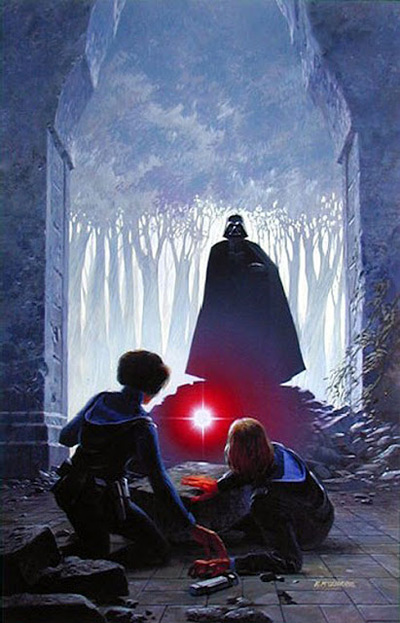
On March 3rd, Star Wars conceptual artist Ralph McQuarrie passed away at age 82. 

Born in Gary, Indiana on 13 June 1929, McQuarrie would move to California in the 1960s where he would find work as a technical artist for Boeing. Soon, after transitioning into Hollywood work, he met a young filmmaker named George Lucas who asked him to take the ideas of his nascent space opera and put them onto canvass. From there, this art became the costumes, props and stop motion models of the original Star Wars trilogy, one of the most captivating and successful film series of all time. 

McQuarrie conceptual art for The Empire Strikes Back
In many respects, I owe a great deal to the partnership of McQuarrie and Lucas. In the early 1990s, I had given up on the superhero genre. It may have been because of the gimmickry and market saturation of that era, but not wanting to give up on comics entirely (and prompted by Timothy Zahn's Heir to the Empire novel) I turned to Dark Horse's Dark Empire comic series. From there I couldn't get a enough of Star Wars and after re-watching the films and reading the comics and novels, my imagination was once again captured by the majesty and grandiosity of that far away galaxy.

Then, in 1995, I was diagnosed with cancer and my entire world was turned upside down. Because the chemotherapy was so potent I was unable to read books -- which meant television and comics were all I could do to entertain myself when not sleeping or getting chemo. Because of this, the Star Wars galaxy became the escapist fare I needed while undergoing treatments and this entertainment was in large part due to the creative genius of Ralph McQuarrie. Thank you, Ralph. 
Cover of the book Splinter of the Mind's Eye by Alan Dean Foster. This story was originally intended to be the low budget Star Wars sequel if the first movie was unsuccessful.  
If you'd like to see some of this man's fantastic art, I've linked to two websites below. I'm also sure there are plenty of comic book artists who owe a debt of gratitude to Ralph McQuarrie too, so if you'd like to share a story please leave a comment in the comments section. If not, enjoy the artwork from the Star Wars and McQuarrie personal websites and I hope to speak with you again soon.

Sunday, February 26, 2012

London Super Comic Convention

This past weekend I attended the London Super Comic Convention at the ExCel Centre in the London Docklands. It was the inaugural event of what I'm sure organizers hope becomes a European San Diego, and while there were a few kinks -- notably the excessively long queues -- it was a good event and featured an impressive array of talent including George Perez, Howard Chaykin, Paul Cornell, Fred Van Lente and the LEGENDARY Stan Lee. 


Here are some choice photos from the day, including some of the trip there. I also found some great British indie comics and will be reviewing them shortly, but for now enjoy the photos and my commentary.   
Walking to Bank Station to head to the London Docklands.
Bank of England, Royal Exchange and a bus
Leaving the Docklands Light Rail to the ExCel Centre.
London Docklands -- once the world's largest port.
ExCel London
Waiting to get in. The queues were were rather long and a first detracted from the overall experience. 
Retailers and fans
The How to Write A Comic Script panel. Unfortunately, the woman on the left was an ad hoc addition and I didn't catch her name. If you know please comment. Other writers (L to R) Mike Carey, Fred Van Lente, Kieron Gillen and Andy Lanning.
Cosplayers 
While waiting for an autograph from Fred Van Lente, Stan appeared to continue signing. It got crazy shortly after I took this photo.
Most of Stan Lee's bodyguards looked like they're former Soviet Special Forces.
Spidey, Stan & Spetsnaz!
Stan Lee: Living the Dream from 1940 to Present Day. At this panel Stan regaled us with some great stories about the beginning of his career, working with Jack Kirby and Steve Ditko on the Fantastic Four and Spider-Man as well as his current and future activities in the entertainment business. Most of the stories were well documented, but it was great to hear them from 'The Man' himself. 
Nuff Said!

Wednesday, February 15, 2012

Thinking about Before Watchmen

The comics world erupted in controversy February 1st when DC Comics announced to it was producing seven new limited series and a one-shot epilogue titled Before Watchmen; prequels of Alan Moore's and Dave Gibbon's masterpiece Watchmen.  Is it crass opportunism or a great strategic move? Protagonists from both sides have been arguing over Twitter, YouTube and the blogosphere in the past weeks and here's my modest contribution to this pan-industry debate. 

A cover to DC's upcoming Rorschach Before Watchmen mini

A cover of DC's upcoming Comedian Before Watchmen mini
From DC's Watchmen #2 originally published October 1986, reprinted in 2008
Frankly, I'm looking forward to them. When the original Watchmen was published in 1986, I had only started reading comics and because of this didn't read the originals when first released. By the early 90s, I had managed to complete them but being used to shorter X-Men and Batman books, didn't take in as much as when I read them again in my 20s. Since, I've enjoyed Watchmen three more times and come to appreciate the story as both a masterpiece of the genre and great introductionary story for my non-comic reading friends.

Nite Owl in DC's Watchmen #1, September 1986 republished in 2008
This history is probably one of the reasons why I'm okay with these prequels. Being relatively new to the story, I'm not as emotionally attached to its original twelve issue presentation as others seem to be. Moreover, I'm also a realist. I know the industry is in a scrap and if this brings in new readers or gives comics publicity in the battle against other forms of entertainment, then I'm all for it. Yes, I know that has me siding with the corporate big-wigs in New York and LA, but there's a simple reality out there -- a profitable comics industry means better stories for us readers and more jobs for comic creators. 
A cover of DC's upcoming Silk Spectre Before Watchmen mini
Which brings me to much used Star Wars argument -- likely something I don't need to explain. And while I'm willing to concede the Star Wars prequel trilogy was a disaster, these new films didn't ruin my love of the original trilogy and Empire Strikes Back remains my favourite film to this day. Because of this, I'm taking a similar view regarding Before Watchmen. If they bomb, the greatness of original series will not be diminished one iota. That said, DC knows it can't drop the ball on this one and that's why they've assembled a great team to do it. Look at the list and you'll see what I mean.
Ozymandias in DC's Watchmen #10, July 1987 republished in 2008 
So if you're already against Before Watchmen, then send DC a message and don’t buy them. Me, I'll be reading, reviewing and (hopefully) enjoying seeing how Ozymandias and Dr. Manhattan became the great characters I know them as. I know not every Before Watchmen comic will be perfect -- but I'm willing to give them a chance and hope they're a successful enterprise for DC. As stated above: the stronger the industry the better the stories for all of us. 

Friday, February 3, 2012

WGTB reviews Winter Soldier #1

This Wednesday, Marvel's Winter Soldier #1, (Ed Brubaker, Butch Guice and Bettie Breitweiser) appeared on the shelves of my local comic shop. And being one of the most hotly anticipated and vigorously promoted new books of 2012, it was one I just couldn't resist picking up.   
Cover of Marvel's Winter Soldier #1, April 2012
There's a gritty, near photographic realism to Winter Soldier #1, April 2012
Like most first issues, there was somewhat of a learning curve to get up with exactly what is happening. I know, I know, this may come as a surprise: Bucky Barnes/Winter Soldier has been very active in the Marvel Universe of late. But I've never been the biggest Captain America reader and had to go back and get caught up with the back story to a degree. But after reading the comic, with Civil War and the Death of Captain America fresh in my mind, I realised that wasn't all that necessary. Brubaker's writing pulled me in and kept the action brisk so that I didn't have time to think about the history of the character. Indeed, the agenda and motivations of Winter Soldier and Black Widow were clear and this, along with the Cold War back story, was more than enough to keep the book moving on its own merits, at times even giving it a Jason Bourne feel.
From Marvel's Winter Soldier #1, April 2012
Guice and Breitweiser's art, with its gritty near photographic realism, really worked with the gritty realist nature of the story, and this series although clearly situated in Marvel's superhero world, has a welcome spy/war comic feel to it. Indeed, at times it actually reminded me a lot of another Brubaker story I've always liked, Gotham Central, which also took place in a world of superheroes yet was not so much about them.

All in all Winter Soldier #1 is a good book even though it will probably take a couple more issues to gather a momentum that will really get me engrossed. That said, the $2.99 price point makes this a real possibility and because of the low price, what would content wise be a 3.5 is actually getting a 4 out of 5 stars.