Showing posts with label Jack Kirby. Show all posts

Sunday, February 8, 2015

King-Size Kirby!

Make sure you check the Diamond Marvel Previews this month. There's a lot coming over the horizon for both the Big Two and the Others, but one of the most notable for students of the history of comics is that a King-Size Kirby hardcover is slated to be available this July. It's going to be a massive 816 pages and $200.00, but it looks like this will be the book to have for fans of Jack "The King" Kirby. I'll start saving the pennies for a review this summer! 

Captain America as drawn by the legendary Jack Kirby. Found the Marvel Previews (February 2015). 

Thursday, August 28, 2014

Happy Birthday to Jack "The King" Kirby!

Today marks what would be the 97th birthday of Jacob Kurtzberg a.k.a. Jack "The King" Kirby. For the few of you who don't know, Jack Kirby is one of the most important artists in the history of comic books and the co-creator of such superhero stalwarts as Captain America, the Fantastic Four, the X-Men, the Hulk, the Avengers, Silver Surfer and Galactus, and so many, many more.

Jack Kirby in 1993, shortly before his passing. Photo by Suzy Skaar. 
Born August 28, 1917 in Lower East Side Manhattan, Jack was the son of Jewish immigrants from Austria. At an early age he found himself to be a gifted artist and this eventually led to a job working on comic strips and graphic images at a newspaper company. Shortly afterwards, he found work drawing parts for film animation and then moved to the Fox Feature Syndicate where he met writer/editor Joe Simon. From there, the pair moved on to Martin Goodman's Timely Comics where Joe and Jack created the iconic Captain America in late 1940, almost a full year before Japanese bombs sunk the USS Arizona at Pearl Harbor. 

Private Jack Kirby home safe and sound after the Second World War. 
Jack himself would go on to serve in the 11th Infantry Regiment and would land at Normandy, although not during the D-Day invasion. With entertainment options limited in the theatre of war and comic books easy to carry and pass around a barracks, there are stories of soldiers reading Captain America during reprieves in the fighting, often at complete unawares that Cap's co-creator was on the base close by. Jack returned state-side in early 1945 after honourable service in the US Army, perhaps most notably at the Battle of the Bulge, the last German offensive of that dreadful war. 

Marvel's Fantastic Four #48 (March 1966) which featured Silver Surfer and Galactus.
Once back in the states, Jack returned to his true calling: art. But when the bottom fell out of superhero comics in the late 1940s, Kirby took to other versions of the funny books. Indeed, after they had reunited, Simon and Kirby created romance comics, a forerunner to young adult-themed cultural phenomena that could even include television programs like Friends or How I Met Your Mother. Kirby's work with Simon would come to an end when the latter moved to advertising, but Jack soon made the move back to Atlas (formerly Timely) Comics and when the Silver Age dawned with the publishing of DC's of Showcase #4 in 1956, Kirby was well-situated to reconnect with his former colleague Stan Lee and create a new group of superheroes. 

Image from Marvel's Fantastic Four #91 (October 1969) This art is classic Jack Kirby. 
"Stan and Jack" would go on populate the Marvel Universe with the Fantastic Four, the X-Men, the Avengers and many more, with the duo becoming some of the most prolific story-tellers in the history of the medium. They were also the gold standard too, with their tales featuring galactic adventures, large-than-life heroes, god-like villains, a resurrected Captain America and Marvel's calling card of the Silver Age: teen angst. Jack Kirby stayed with Marvel until the early 1970s when he was enticed to cross the street and move to DC. While at the "Distinguished Competition" Jack took the reigns of Superman's Pal, Jimmy Olsen (a poor selling book so he wouldn't take anyone's job) and created the highly serialized and archetype-rich science-fiction epic Jack Kirby's Fourth World as well as characters OMAC and Kamandi. In the mid 1970s Jack returned to Marvel for a short, final time where he created fan favourites The Eternals, among a few others.

Kirby art in Pacific Comics' Captain Victory and the Galactic Rangers #3 (March 1982).
After a brief stint in animation in the late 1970s where he worked on such awesome stories as Thundaar The Barbarian, Jack returned to the funny books once again to do work that we would now label "creator owned". This choice of phrase is both apt and ironic due to on-going legal issues relating to the ownership of Kirby's co-creations at Marvel, issues that may yet be heard before the Supreme Court of the United States. But that is a sordid tale for another blog entry (or even a book).

Jack Kirby's self-portrait. It features many characters he co-created and developed at Marvel Comics. 
Jack Kirby passed away on February 6, 1994 at the age of 76. When your humble blogger became re-acquainted with comic books after a decade-plus hiatus, it the re-discovery of Jack Kirby's art that drew me in and indirectly led to the creation and naming of this blog. WGTB loves Kirby's larger-than-life characters, his legendary "Kirby Krackle" and the dynamism of almost any page he has ever drawn. So happy birthday, King! You're well and truly missed and have legions of supporters and fans who will ensure your name is never forgotten.

Sunday, March 17, 2013

WGTB Reviews Marvel Comics: The Untold Story

Hello, friends. First off, my sincere apologies for not writing in the last little while -- it has been a very busy winter for me. But while taking a brief sabbatical from WGTB, I did manage to read a book that was released in the latter half of 2012 called Marvel Comics: The Untold Story by journalist and former editor of Entertainment Weekly, Sean Howe.  

Marvel Comics: The Untold Story, Sean Howe, Harper, 2012, 485 pp, $26.99
Beginning with Timely Comics, the first incarnation of the company, Marvel Comics: The Untold Story takes its reader on the journey of Marvel from its conception to its current incarnation as one of the jewels in the crown of the Disney empire. The book itself is divided into five parts, each with their own manageable chapters. These parts, logically divided, cover the company’s origins; its renaissance during the 60s rebirth of the superhero genre; the mostly dreary and sometimes incomprehensible 70s; the sometimes acrimonious but always interesting period of Jim Shooter as Editor-in-Chief; the boom and bust period of the 90s and finally, the modern period of corporate restructuring and Marvel’s apotheosis in the cinematic world.   

The book itself is compulsively readable and does not seem the nearly five hundred pages it is. It is meticulously well researched and especially good at detailing the complex and often vitriolic drama that has dominated much of Marvel’s history. Of course, most of us know of the intellectual property disputes that still dominate Jack Kirby’s estate, but Untold also does a great job at explaining the many similar conflicts that occurred in the 70s and 80s that are much less well known. Further to that, it takes careful attention to document the fascinating history of the Editor-in-chief tenure of Jim Shooter. I knew much less about this but was absolutely enthralled while reading about it. 

But for me, by far the most interesting section of the book was Howe’s examination into the boom and bust period of the 90s when, after selling millions of comic books, Marvel nearly collapsed upon itself in a fury of corporate overreaching and greed. Readers of this blog will note that this has long been of particular interest to this blogger, but even with that background, I was impressed by Howe's research and the considerable depth of his explanations. Naturally, with Marvel's top books now selling a fraction of what they did in the early 90s, there’s an instinct to think that a comic book bubble will never happen again and therefore a warning is not necessary. But exposés of any boom and bust are always important and always serve as a warning to any industry or business -- especially those were demand is rooted in the ebb and flow of what is popular. 

In a couple places the book it could use more dates or year descriptions to assist the reader who is not as well versed in 70s or 80s comic book lore. Likewise, with so many names, it was helpful to have a tablet computer close just to periodically check when another unknown artist, writer or inker’s name surfaces. But these small matters aside, Marvel Comics: The Untold Story is a great work of comics journalism and fascinating survey of an area of pop culture and creative genius that has left an indelible print on the modern world. It is not to be missed. 4.5/5 STARS.

Sunday, October 28, 2012

SuperSoundtracks #6: The Silver Surfer & Babylon Zoo

Welcome to another super-soundtrack blog entry. In this (somewhat) regular feature, I take a good song and pair it with a comic book character. Today's comic subject is yet another creation from the minds of Stan Lee and Jack Kirby; a character who first appeared with his master Galactus in the pages of Fantastic Four in March 1966. The musical subject today is the mid-90s hit 'Spaceman' by the English band Babylon Zoo.

An advert from The Avengers #25 (February 1966) This blogger (shamefully) doesn't own a copy of Fantastic Four #48 (March 1968)
Hailing from the highly advanced world of Zenn-La, the Silver Surfer was originally a scientist named Norrin Radd. When Galactus, the god-like devourer of worlds arrived at his home planet to consume it, Radd took a long unused spaceship and flew to Galactus for a parley. The resulting deal he struck was that he would serve as 'Herald' to Galactus and spare both his and other inhabited planets that Galactus would normally feed upon.    

The Silver Surfer is born! From (Silver Surfer Vol. 2 #1 1982)
At first this bargain served both parties well. Galactus, slow and cumbersome, was able to devour planets that were void of life and thus spare living creatures. At the same time, Norrin Radd as the Silver Surfer was able to explore the universe. But when the two came upon Earth conflict ensued: the Surfer grew to care about the humans while Galactus needed to eat them. Ultimately, when he aided the Fantastic Four in saving their planet, the Silver Surfer was released from Galactus' service and bound to the planet he helped spare as punishment.

Splash from Silver Surfer Vol. 2 #1 (1982). This one-shot told about the Surfer's Earth-bound captivity and starts with him in despair. Script by Stan Lee and plot and pencils by John Byrne.
It also featured a back story for readers not familiar with his creation story and...
...culminated with a conflict involving the Silver Surfer battling Mephisto. The Silver Surfer is very much an angelic presence in the Marvel Universe and it's fitting that he would count its devil as one of his chief adversaries. Above images also from Silver Surfer Vol. 2 #1.
The Silver Surfer is among the most popular characters in the Marvel Universe and has had many great creators take their turn at writing and drawing him. After appearances in the Fantastic Four he was given his own book for a short time between 1968 and 1970. This 18 issue series was silly in parts, yet is still well received to this day. Since then, the Silver Surfer (and Galactus) have appeared in many guest spots, minis and one-shots and between 1987 and 1998 Volume #3 of the Silver Surfer ran for 146 issues, an impressive run especially since it survived the mid-90s comics bubble. More recently, when it launched in 2011, The Mighty Thor featured a great opening story starring the Silver Surfer and in late 2011 Matt Fracton and Terry Dodson's Defenders also included the Silver Surfer. So far I haven't heard what Marvel NOW! plans to do with this cosmic hero, but we will be watching.
The Silver Surfer battles a pirate in the service of Mephisto in Silver Surfer Vol. 1 #9 (October 1969)
Marvel's (Marvel Knights) Silver Surfer: Requiem (July 2007) Writing by J. Michael Straczynski & art by Esab Ribic
Croatian artist Esad Ribic's work was especially good in Silver Surfer: Requiem (July 2007)
Today’s super-soundtrack chosen for the Silver Surfer is ‘Spaceman’ by Babylon Zoo, a band from Wolverhampton, England. You may remember these guys: especially if you're from the UK and heard them rocket to the top of the charts in early 1996. Unfortunately, this early success did not translate into long-term viability, and they quickly fell off the music map after their first album. Interestingly, it appears that Babylon Zoo were comic book fans -- their second album featured a song called ‘Chrome Invader’ which was originally called 'Silver Surfer' but was changed for copyright reasons. 


Spaceman is a cosmic-sounding mash of psychedelic and indie/alternative musical styles. With hauntingly slow lyrics, heavy beats and at times spoken words, it certainly has a mid-90s feel to it, yet still holds up to the 2012 listener. Its lyrics are also very appropriate to the Silver Surfer, with the below sample being particularly well matched:    
 There's a fire between us  
So where is your God?  
There's a fire between us  
I can't get off the carousel
I can't get off the carousel 

I can't get off the carousel 
I can't get off this world

If you can think of another song that would match the Silver Surfer or have a super-soundtrack of your own, please leave a comment below. That's it for now, so thanks again for reading and with the Marvel NOW! coming soon look for more reviews in the weeks to come.

Sunday, July 1, 2012

Happy Canada Day!

To mark the occasion here are my top five 'Canada and Comics' convergences. Enjoy:

5) Wolverine joins the X-Men.

All Images from Marvel's Giant-Sixe X-Men first published in 1975 and reprinted in 1991.

This could be considered treason by some, but I think by taking a potentially one-off character and putting him in the X-Men, Marvel gave this Canadian front-line exposure which allowed him to reach the prominence he would later experience.
 
4) First appearance of Captain Canuck. 

From Comely Comix Captain Canuck #1 (July 1975)
What's a Canadian comic without a snowmobile? From Captain Canuck #1.
This book featuring a Captain America look-a-like was released by Comely Comix in 1975. It featured a future where Canada had eclipsed the USA as a superpower and was as much science-fiction as it was superhero. Captain Canuck has since been featured on a postage stamp and there's even talk of a feature film. 
3) Logan fights on D-Day

All images from the great book Marvel's Wolverine #34 (December 1990) written by Larry Hama with art by Marc Sivestri.


Probably the least well known of this list; in Wolverine #34 we learn Logan (Wolverine) jumped on D-Day. Canadian troops launched at Juno Beach during Operation Overlord and played an important role in beating back the Nazi menace during the entire Second World War. Go Canada!  

2) Prisoners of Gravity

This Canadian television program remains (thanks to YouTube) a great source for anyone interested in the history of our medium. It has been talked about on such prominent podcasts as Word Balloon and has one of my favourite interviews with Jack Kirby. Have a look.

1) Alpha Flight Arrives!

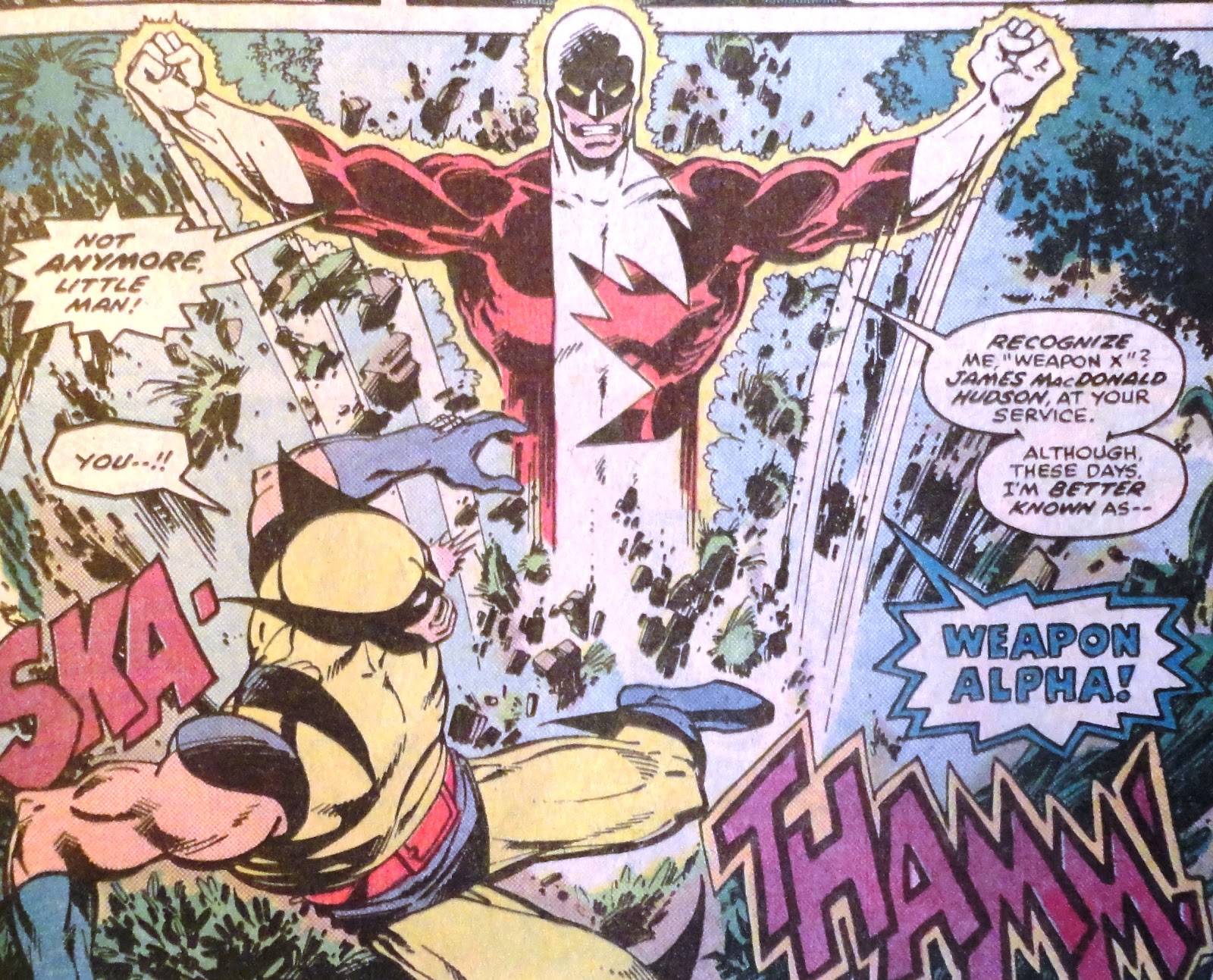
The story of the first meeting between Alpha Flight and the X-Men. From Marvel's Alpha Flight #17 (December 1984)
From Marvel's Alpha Flight #1 (August 1983)
Alpha Flight first appeared in Uncanny X-Men #120 (1979). Created by John Byrne, this group would eventually get its own series and give comics readers a number of great characters and moments. Northstar, one of the original Alphans, has come to prominence in recent weeks as one half of the first same-sex marriage in the Marvel Universe.

So there you go. Have a great Canada Day and thanks again for reading.