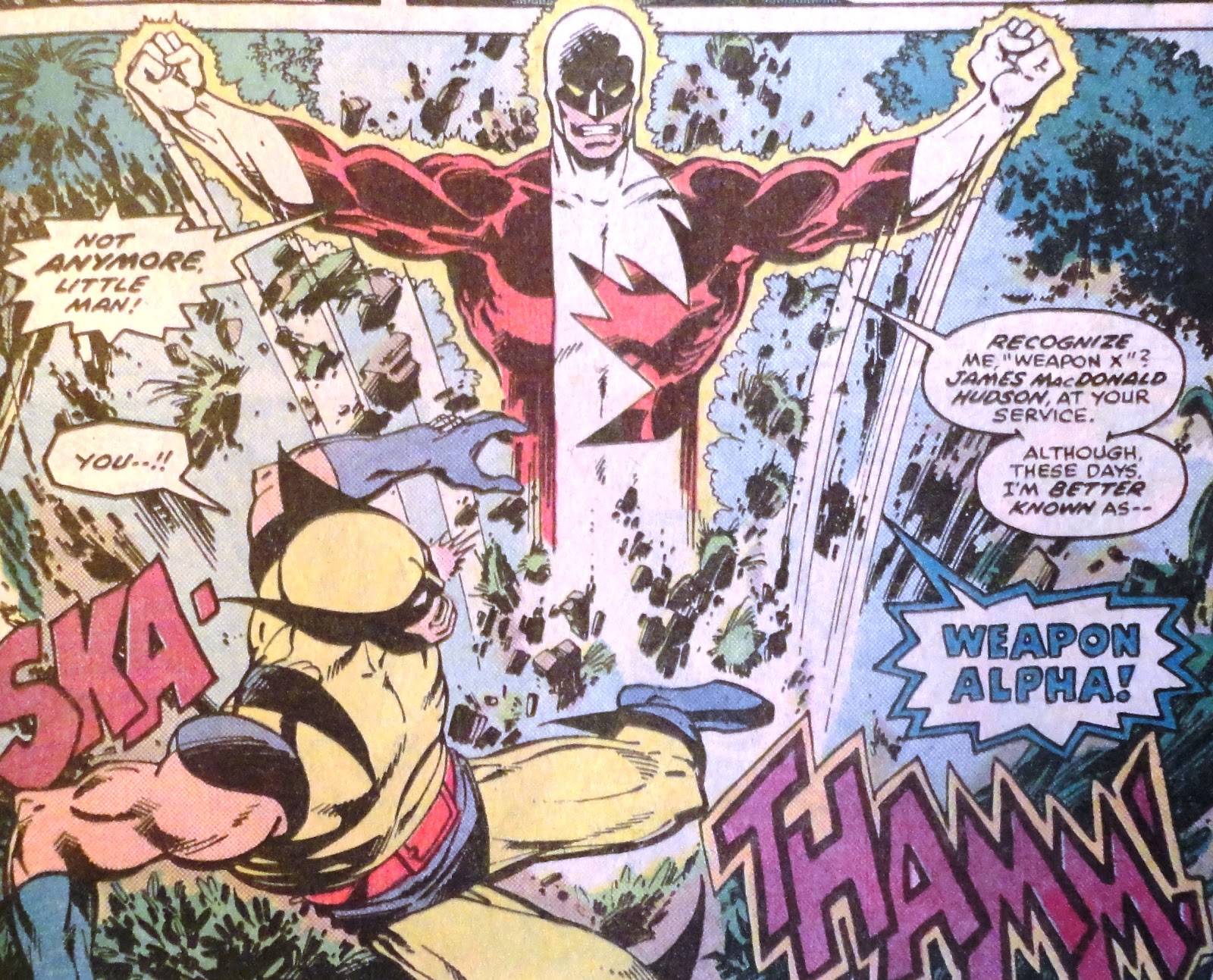
Recently, WGTB picked up Alpha Flight #0.1, Alpha Flight: Fear Itself #1 and Alpha Flight: Fear Itself #2. Number 0.1 mostly consisted of an intense battle and a re-introduction to the AF characters while #1 and #2 begin to craft, what is already looking like a great story. So, while this blog entry was originally intended to be a review of the Alpha Flight: Fear Itself comics, while reading #1, we can across a very interesting panel that took it into an entirely different direction. As such, this is not a review of the comic: but WGTB would like to recommend it because it's very good so far.

In AF-FI, the Canadian people have elected a new ‘Unity Party’ government. This political party, we are told, is neither Left nor Right, but seeks a ‘new way’ to govern Canada. We soon learn -- from both #1 and in a follow-up interview with Fred Van Lente and Greg Pak -- that Canada is about to be taken into an ‘interesting and dangerous’ direction. Number 1 begins with Vancouver under siege -- this time not by crazy hockey fans -- but by Nerkkod, an aquatic monster. Alpha Flight eventually wins but after the successful battle, the new prime minister makes a startling announcement:


(Above images from Marvel's Alpha Flight: Fear Itself #1, 2011)
WGTB was struck by these panels and immediately asked ourselves if this was even legal. Clearly, the creators intent is to make the prime minister ultra powerful by imposing martial law and suspending the Charter of Rights and Freedoms. But in the real world could the Prime Minister of Canada do this? To answer this question we must examine the history of the Charter of Rights and Freedoms as well as how it functions in the current day.

(The Centre Block and the Prime Minister's office in Marvel's Alpha Flight Vol.1 #13, 1984. The actual office is much less grand)
Unlike the Bill of Rights of the United States, of which many WGTB readers are familiar, the Canadian Charter of Rights in Freedoms is a relatively new document – having only been enacted in 1982. Prior to this, Canada did not have entrenched rights like our American neighbours, but like the United Kingdom, had a parliament that was supreme which made statutes that were only interpreted by judges and not struck down. This system was not without safeguards, but these were mostly vigilant judges and opposition parliamentarians working with either common law decisions or constitutional conventions (most of which were also inherited from the United Kingdom). For instance, the ancient rights of Magna Carta or the Bill of Rights of 1689 or legislation concerning British North America such as the Quebec Act, 1774 or the provisions for Responsible Government in Nova Scotia (1848), while not entrenched, had substantial importance. In 1867, the year associated with Canada’s formation, the British North America Act was passed in Westminster which united the three colonies of Canada, Nova Scotia and New Brunswick into four provincial and one Dominion governments. Responsibilities of state were divided between two levels of government – both which were sovereign in their areas of jurisdiction. London freely gave up rights to legislate without Canada’s consent with the Statute of Westminster in 1931 and shortly afterwards it has held that Canada, while not legally independent, was in Lord Sankey’s words “in enjoyment of the full scope of self-government.”
After the horrors of World War II, a wave of human and civil rights agreements and legislation swept across the western world. In 1960, Conservative Prime Minister John Diefenbaker’s government passed the Canadian Bill of Rights. This, however, was only a federal statute and could be repealed by the Canadian parliament. It also did not apply to Canada’s provinces.
Things changed drastically in the 70s and 80s when Prime Minister Pierre Trudeau sought to patriate the Canadian constitution and completely severe all legal ties with the United Kingdom. (Queen Elizabeth II would remain as Sovereign, but as the 'Queen of Canada'.) When the Supreme Court held that convention required a substantial degree of provincial consent, Trudeau used the negotiations with his provincial colleagues to give Canada entrenched rights that could not be taken by the federal parliament or provincial legislatures. This was a long and vexing process, but ultimately the Constitution Act, 1982 was passed with the Charter of Rights and Freedoms, as its first 34 sections. This Charter included six broad categories of rights:
Fundamental Freedoms which include: rights of conscience, religion, thought, belief, opinion, expression, assembly and association.
Democratic Rights which include: rights to vote in regular elections and annual parliaments
Mobility Rights including: the right to enter and leave Canada and reside in any province or territory.
Legal Rights relating to criminal procedure which include the right to retain and instruct counsel, Habeas Corpus, a trail within reasonable time, presumption of innocence until proven guilty, Life, Liberty and Security of the person and a freedom from denial of this unless fundamental justice is at stake.
Equality Rights which include equality before and under law and equal protection and the benefit of law; and
Language Rights which includes official bilingualism in Canada
The Charter is much longer than its southern cousin, and is a product of both the fiery negotiations and bi-jural perspectives of the politicians who created it. The English-speaking premiers of the provincial governments came from jurisdictions that had a strong Commonwealth tradition of parliamentary supremacy and many (on both the Left and Right) viewed entrenched rights with suspicion. The Quebecois Trudeau, hailing from a jurisdiction that had a Civil Law Code and a different legal history, had seen what a heavy-handed provincial government could do with parliamentary supremacy and sought to prevent episodes such that which led to the famous Supreme Court decision in Roncarelli v Duplessis (1959). The Canadian public was also overwhelmingly supportive of a Charter and because of this the premiers did not risk opposition to the idea.
Ultimately the camps settled on a compromise between entrenched rights and parliamentary supremacy. The Charter would entrench rights but its penultimate Section 33 allowed for a Legislative Override, and reversion to parliamentary supremacy if a legislature attached this Notwithstanding Clause. The Notwithstanding Clause did not apply to the mobility, language or democratic rights (which were counted as inalienable) and as such, a legislature could not use it to lengthen its existence indefinitely or limit language rights. It also had a five year sunset provision which guaranteed that if rights were suspended a legislature would have to eventually face the electorate for it.
Sections of the Charter that are subject to a legislative override include Fundamental Rights, including freedom of expression, religion, association; Legal Rights including rights to liberty and right to be secure against unlawful search and seizure, freedom from cruel and unusual punishment; and Equality Rights, which courts have determined includes same-sex marriage.
Which brings up back to Alpha Flight: Fear Itself #1 and the legality of the Prime Minister’s Emergencies Act, 2011. Strictly speaking, while the Prime Minister CANNOT suspend the Charter -- this is beyond his/her authority and would require co-operation from provincial governments -- the Emergencies Act could contain the Notwithstanding Clause in areas of federal jurisdiction, thereby making many of its draconian measures legal.

(Ottawa from Marvel's Alpha Flight Vol 1. #13, 1984 - The author once lived in one of the distant apartment buildings)
That said, things could get complicated given that policing and the courts are provincial responsibilities and the Prime Minister or the Attorney-General of Canada could very well be opposed by provincial leaders against the use of Police and Crown Prosecutors for such draconian measures. Of course, it could lead to even more trouble given that seven provinces contract their rural policing out to the Royal Canadian Mounted Police, who are ultimately controlled by the federal Minister of Public Safety. WGTB is not sure who controls Department H but it is likely this minister as well.

(RCMP with the most famous former Depertment H employee. Marvel's Wolverine Vol.2 # 34, 1990)
WGTB is a long-time lover of Alpha Flight and will continue to enjoy this Fear Itself mini-series. We did not intend to be annoying Simpsons-style Fanboy critics while writing this one – Alpha Flight exists in Earth-616 where the Canadian prime minister has as much legal power as Fred Van Lente and Greg Pak want to give him. But we hope you have enjoyed this opportunity to learn about Canadian Constitutional law and hope it has increased (or at least not decreased!) your interest in Canada’s rich yet evolving legal heritage.

(Guardian in Marvel's Alpha Flight Vol. 1 #17, 1984)
NEXT: Alpha Flight: Fear Itself #2 contained a panel where the police arrested the the Leader of the Opposition. Is this legal? Stay tuned for the next Alpha Flight and Canada to find out!