Showing posts with label Japan. Show all posts

Saturday, November 22, 2014

SuperSoundtracks #8: Robotech: Macross & Daft Punk

For a little over a year in the early 2000s, I lived and worked in Tokyo, Japan. At a train transfer on my commute home there was a department store that had on its sixth floor a store called Hobby Base: Yellow Submarine. This store (and others like it in Japan) was awesome but while visiting I was always drawn back to the mecha models, especially those I identified as belonging to Robotech. So for WGTB's SuperSoundtrack #8 I'm going to focus on Robotech: Macross and what I think is the best track of the 2013 hit album by French electronic duo Daft Punk

The Cover of the Robotech Role Playing Game by Palladium Books.
Robotech was one of the earliest mecha-based Japanese programs to be consumed in large numbers by Western audiences. The whole thing started when Jim Rocknowsky, a product director for the US company Harmony Gold, discovered three Japanese programs: Super Dimension Fortress Macross, Super Dimension Calvary Southern Cross and Genesis Climber Mospeada and decided to licence and merge them into one 85 episode saga, combining remarkable science-fiction visuals with mature and often very personal stories. Upon getting the licence Harmony Gold's president, Frank Agrama, set about  assembling a team that would make this Japanese story enjoyable for Western audiences. This wasn't easy and included not just dubbing the dialogue, but also finding skilled actors to bring the characters to life, writing an appropriate musical score and tying these three desperate stories together into one plausible back story. The first of the three parts or Robotech would become known as the The Macross Saga and is the one I'm most familiar with.
Image from Comico's Robotech: The Macross Saga #13 (August 1986).
The story went as follows: In the year 1999, humanity was not doing well. Global war was ravaging the planet and it was against this backdrop that astronomers discovered an alien spacecraft heading towards Earth. When the alien ship eventually collides with Earth, it ends up on the fictional Macross Island located in the south Pacific. Miraculously, the ship survives and remains intact, which spurs forth a human effort to reform our ways and soon afterwards a United Earth Government is formed. Simultaneously, a team of researchers and scientists arrive at the island to investigate and learn from the alien ship. 

Image from Comico's Robotech: The Macross Saga #5 (August 1985).
Over time, Macross Island grows from a sparsely populated island to a bustling hive of humanity. Macross City becomes its metropolis, which grows up around what becomes known as the Super Dimension Fortress One (SDF-1). By 2009, it's decided that humanity will launch the ship and command is given to a Frenchman named Captain Henry J. Gloval. His First Officer is a woman named Lisa Hayes and a leader of the robot-fighter aircraft that defends it is Commander Roy Fokker. During the launch ceremonies, a young hotshot pilot named Rick Hunter crashes the party, but his actions are also interrupted when the Zentradi, the previous owners of the SDF-1 arrive to reclaim their property. The Zentradi are a warrior race of green giants who are genetically bred for fighting and when they arrive the First Robotech War begins!
Roy Fokker and Rick Hunter. While not brothers in a biological sense, Rick would call Roy his "Older Brother" and much of the early Macross story centred around Rick going from talented young hotshot to mature military commander -- much of which was the result of Roy's death. Image from Comico's Robotech:The Macross Saga #5 (August 1985).
The humans make a valiant effort to defend themselves and Rick Hunter soon finds himself in a Veritech fighter, the mainstay of the SDF-1's fighter wing, itself a piece of "Robotechnology" which was inspired by the SDF-1. In the heat of the battle, it becomes clear that while the Zentradi have both greater technology and numbers, they also want their ship back and this means using restraint when fighting the humans. In the course of the battle, the humans hyperspace jump to Pluto, and then begin the voyage home, harangued by the alien invaders and isolated from their home planet. 

The SDF-1 transformed. The choice of word is intentional. From Comico's Robotech:The Macross Saga #5 (August 1985)
The faux-technology of Macross was the centre-piece of this part of Robotech and was quite cool. On humanity's side, there was the Veritechs. There was a number of different models of these fighters but the key element to them was they were spacecraft that could transform into a "Battloid" robot, which stood 42 feet high. If the technology sounds familiar to the Transformers line of toys, this is because both were designed by Shōji Kawamori. Indeed, both the Veritechs and Optimus Prime (and many of the early Autobot) molds came from this prolific designer. Indeed, the Autobot "Jetfire" was a VF-1 Valkyrie Veritech fighter. 

Vertiechs and battlepods in Comico's Robotech: The Macross Saga #13 (August 1986)
Eventually the two sides fight to a standstill and when the Zentradi leader, an alien named Exedore, seeks peace with Gloval, it is made known that a new Zentradi fleet is en route to Earth. When it arrives, the SDF-1 is destroyed after it rams the enemy flagship. Earth, however is left in ruins and the remains of the SDF-1 land in the middle of North America, where they once again form the basis for a new city. With this, the Macross Saga ends. 

While Robotech was at its most visible as a cartoon show, it would go on to spawn a multi-media empire with a role playing game, novels, toys and comic books: all of which provided young audiences with multiple means to devour this fictional universe. The comic book licence has its own interesting story. Starting with a short two-issue DC Comics mini-series, which used the model sets made by Revell and not the Japanese anime, it was the Pennsylvania-based Comico that published an initial graphic novel and then the ongoing series based on the Marcoss, Masters and New Generation series. In 1989 the licence went over to a Malibu Comics imprint named Eternity Comics, who published black and white stories until the licence moved over to the obscure Antarctic Press for only two years in the late 1990s. The licence would bounce back to DC Comics in the early 2000s, this time to the Wildstorm imprint in a effort to reboot the entire line. Then, in late 2013 (and partially reviewed on this blog) DC and Harmony Gold licenced it to Dynamite Entertainment where it was featured in a Robotech/Voltron crossover. 

Cover of Random Access Memories by Daft Punk.
For SuperSoundtrack #8 I've decided to pair Robotech: Macross with a song off the 2013 Grammy Awards Album of the Year Random Access Memories by the French electronic band Daft Punk. Now you may remember the massively popular single Get Lucky with its electronically fused funk beats and Pharrell Williams' catchy lyrics, but that isn't the chosen song.   

Daft Punk is a musical duo consisting of Frenchmen Guy-Manuel de Homem-Christo and Thomas Bangalter. Their first album Homework (1997) was a club staple in the late 90s, but I started to love them when I purchased their 2001 release Discovery, which was featured in the Franco-Japanese anime film Interstella 5555: The 5tory of the 5ecret 5tar 5ystem. Human After All (2004) wasn't a favourite but Random Access Memories has more than made up for it. They also wrote the soundtrack for the 2010 film Tron: Legacy. The robot personae has been a feature of the group from their earliest days.    
No, the honour of SuperSoundtrack #8 goes to the track named Touch. Like its sibling, Get Lucky, Touch has funk-infused beats and melodies, but it's also orchestral and space-like/electronic in places as well. Because of this, it really plays to the operatic aspect of Macross and at times, the lyrical refrain "If love is the answer you're home" along with the electronically-fused, cosmically reaching melodies, which themselves are followed by a beautiful arrangement of strings, makes this track the best on an already outstanding album. The lyrics are provided by the versatile Paul Williams, and it's so good, that although it's over eight minutes long, it seems to finish quite quickly. Have a listen and see for yourself if you can picture Roy Fokker, Rick Hunter and Lisa Hayes doing what they can to save humanity. 

Robotech wasn't the first Japanese cultural export to find its way to North American shores, nor will it be the last. Astro Boy, Speed Racer, Battle of the Planets, Mobile Suit Gundam, along with live-action exports like the Power Rangers have also been very popular here. (And this isn't even including original Japanese concepts like the Diaclone that were, um, transformed upon reaching North American markets.) But Robotech was special and remains, for me at least, a first contact point with Japanese sci-fi culture; something I would enjoy very much when living and working in Tokyo. Thanks for reading and if you have any suggestions for a SuperSoundtrack please leave it in the comment section below.

Wednesday, October 1, 2014

Addendum Review: Showa 1939-1944: A History of Japan by Shigeru Mizuki

A few months ago I reviewed a graphic novel by legendary Japanese artist Shigeru Mizuki and released to English-speaking audiences by Canadian publisher Drawn & Quarterly. Quite simply, it was fantastic and towards the end of the review I mentioned there was a follow-up coming in June 2014. Well, I recently read that second volume and have to say it is even better than the previous edition. The most recent portion of Mizuki's epic account of Japan in the early 20th century, Showa: A History of Japan 1939-1944  took his story into the late 30s and early 40s which saw the Empire of Japan attack the United States of America and the bulk of the war in the Pacific. 

Showa 1939-1944: A History of Japan, Shigeru Mizuki, Drawn and Quarterly, 2013, pp. 548, C$24.95
I don't have much substantively to add to my previous review, but have captured some choice images for you to enjoy and hopefully this will give you an additional sense of just how masterfully drawn and insightfully told both of these books are. Simply put, Muzuki is an outstanding storyteller and I hope you read/buy/enjoy these remarkable books. Suffice it to say, Showa 1939-1944 gets a near perfect 4.7/5 STARS (the highest we've ever given) and so you really enjoy the images below, we've captioned them with some history to explain their historical significance. Thanks for stopping by!   

This panel is especially interesting. We all know of the Molotov-Ribbentrop Pact which was signed by the Soviet and Nazi foreign ministers in August 1939 and promised non-aggression between those two totalitarian states. But the treaty had Pacific ramifications too. Because of their invasion of Manchuria (China), the Japanese also had an undeclared border war with the Soviet Union in the late 1930s which was of concern to both governments. Earlier, in November 1936, the Nazis and Japanese has also signed an Anti-Comintern Pact against the Russians and then in April 1941, the Japanese and Soviets, in an effort to limit exposure on their western and eastern flanks, signed a Soviet-Japanese Neutrality Pact. Apparently Hitler was not very pleased. 


An image from a Japanese warship on the eve of the Pearl Harbor Attack. While President Roosevelt had made efforts to involve the US in the Second World War, it was the Pearl Harbor attack that brought the Americans into the war in a very violent fashion. Shortly after the Japanese declared war, the Germans followed suit.    

Mizuki's scene from the Battle of Midway which took place in June 1942, seven months after the attack on Pearl Harbor. Midway Atoll is north-west of the Hawaiian archipelago and was considered a key strategic location of the Pacific. The Battle of Midway itself is considered one of the most important battles of the Pacific war and Japanese war leader Admiral-Marshal Isoroku Yamamoto proved quite prophetic when he promised his government: "I can run wild for six months … after that, I have no expectation of success". Yamamoto was very close to the mark because Midway was the turning point of the Pacific War and started the American push into the Japanese "Co-Prosperity Sphere".  The Harvard trained and English-speaking Yamamoto said in reference to Pearl Harbour: "I fear all we have done is to awaken a sleeping giant and fill him with a terrible resolve." He was right there too. 


The USS Enterprise. The "Big E" was the most decorated US naval ship in the entire war.  

An image from the Battle of Sunda Straight. Mizuki's black and white images of air and sea battles are hauntingly serious and accurate.  


Here's more use of black and white to describe the naval war in the south Pacific Ocean. 


But despite Mizuki discussing a very serious topic, he also takes care to maintain levity, wit and humour throughout the story...


...and at one point even includes an instance where he had a very disgusting mishap with an army latrine. Uck!


But ultimately Mizuki comes back to the futility and waist of the Japanese war effort and the derangement of Prime Minister Hideki Tōjō. Here the prime minister talks about a Japanese parade down Whitehall (London) and imperial battleships in New York harbor.


Sunday, July 13, 2014

Exploring Japan Through Comics: WGTB Reviews 47 Ronin: The Tale of the Loyal Retainers & Showa 1926-1939: A History of Japan

When you think of Japan, you might think of electronics, bullet trains and Mt. Fuji. Or perhaps it’s sushi and the plethora of talented baseball players we have seen in North America in recent decades. Whatever it is one thing is certain: Japan is a fascinating and complex place with remarkable people. I know this personally because in the early 2000s I was fortunate to live and work there for a year. It was truly a memorable experience and I've since always been on the lookout for material on Japan, especially when it relates to its amazing history.  

47 Ronin: The Tale of the Loyal Retainers, Mike Richardson & Stan Sakai, Dark Horse Books, 2014, pp. 152, US$19.99
Which is why when I noticed two graphic novels recently at the local bookstore, I just had to have (and review) them. They were 47 Ronin: The Tale of the Loyal Retainers by Mike Richardson and Stan Sakai and published by Dark Horse Comics and Showa 1926-1939: A History of Japan by manga legend Shigeru Mizuki and published by Canadian publisher Drawn and Quarterly. Both books are enjoyable examinations of two key periods in Japanese history, the former being that of the Tokugawa Shogunate (1603-1868) and the latter of the early Showa period. "Shōwa" which translated means "enlightened peace" is the posthumous name given to the era of the reign of Emperor Hirohito which lasted from 1926 to 1989.  

Showa 1926-1939: A History of Japan, Shigeru Mizuki, Drawn and Quarterly, 2013, pp. 560, C$24.95
It's a truism to say that Japan has a very long and complex history. Indeed, the Emperor (Japan remains the only state to have kept the title "Emperor" for its monarch) claims issue from a line that reaches back five thousand years. The reason for this is that unlike European monarchies which seem to attract dynastic rivalries and wars, revolutions or parliaments who simply select distant relatives over closer yet undesirable ones, (Here I speak of King George I who, upon ascending the British throne, overtook more than fifty other candidates because they were Roman Catholic), the Japanese emperor has always been sacrosanct with the actual power found in the office of "shōgun" (Japanese for "general") who even with dictatorial powers would never consider eliminating the sacred emperor.

Modern Japanese history can be said to begin in the seismic year of 1603, when the warrior Tokugawa Ieyasu was declared Shogun and started a dynasty that would rule Japan until power was taken back by the Emperor over 265 years later in the Meiji Restoration of 1868. In the two and a half centuries the Tokugawa shoguns ruled Japan the country found a measure of stability and order. The backbone of the the Tokugawa Shogunate were the samurai, a military nobility of warrior-retainers who maintained the feudal system of government and had as their ethos "Bushido", a chivalric concept that stressed loyalty, martial prowess, honour and if need be: death. Indeed, death was often occasioned by one’s own hand in a from of ritual suicide called suppuku. The Tokugawa Shogunate gradually built this system into law and along with the self-imposed isolation from the rest of the world led to a stable yet isolated society that remained largely unchanged until the US Navy arrived in Tokyo harbour in 1853, an event which spurred forth efforts that led to the Meiji Restoration and subsequent modernization.  

47 Ronin is a story that epitomises the samurai ethos of medieval Japan. It tells the story of Lord Asano, a daimyo lord who is called to Edo (Tokyo) in 1701. During this period the law required lords to attend the capital for a period so the Shogun could maintain control over them. While in Edo, Lord Asano does not play the courtier’s game and when he refuses to pay a corrupt official he subsequently becomes the target of provocation and insult until he draws his sword in the Shogun's palace, a crime that comes with the punishment of death. After Asano is forced to commit seppuku, 47 of his loyal retainers, now themselves ronin or masterless samurai plot posthumous revenge and eventually take action. 

A splash from Dark Horse's 47 Ronin

The art is great at conveying feudal Japan without...
The book is an enjoyable book and worthy investigation into Japanese history and samurai culture. Richardson's writing presents an old story in a accessible and amusing way and while I was often told in Japan that it is a country of nuance, this isn't so much the case and anyone interested in Japanese culture can pick it up and enjoy it. Much same can be said for Stan Sakai's art, which, while saying it has a juvenile quality to it would be unfair, it is never-the-less powerful and refined in a uncomplicated way. All of this brings about a collection of artwork that is not over-the-top or silly but a worthy interpretation of a great story. 4/5 STARS 

...the romanticizing that is often found in Western depictions of the samurai culture.

The 47 Ronin is a old and complex tale. "To know this story is to know Japan" reads back cover of the Dark Horse edition. I'm not sure if this is true, but it is a national legend and 47 Ronin is a worthy retelling of it.  
Our second book takes us well past the Meiji Restoration and into the early portion of the reign of Hirohito. By the end of First World War, Japan was starting to flex its geopolitical muscle. A surprise victor in the Russo-Japanese War of 1905 and entering on the side of the eventual winners of the First World War, Japan was spurred forth by these successes in the early 1900s and this had lasting ramifications. In Showa 1926-1939: A History of Japan Shigeru Mizuki examines much of the Japanese aggression of the early 20th century through the eyes of his own childhood. Born in 1922 in a town on the southern edge of the largest island of Honshu, Mizuki's work is both a history of the early Showa era and an autobiography of his early life and the struggles he experienced in a country that was both a expanding and militarizing. It tells a story of not just family and school struggles but also the Japanese response to the Great Kanto Earthquake (1923), the Great Depression, the Washington Naval Treaty, military expansion into Korea and China and ultimately joining the Axis powers in the lead up to the attack on Pearl Harbor.

The personal and historical are intertwined in Showa 1926-1939: A History of Japan by manga legend Shigeru Mizuke. Here he draws his first day of school.

The historical aspects of the story are made with a non-manga clarity. Here Showa discusses the Great Depression.
I've not enjoyed comic book history like this in a long, long while. Showa is not only a great book, but also a great way to learn about Japan. In an interesting and excellently chosen feature, the funny and more personally inspired vignettes are more cartoonish, whereas more photo-realistic images are chosen for historical events. This all lends itself to textual and pictorial gravitas where it's needed and a sense of humour and valuable comedic insights when they're needed too. Living in a tumultuous and changing economic and political climate is never easy but this book makes fine work of that while at the same time not leaving the reader in a depressed state. All of this leads to a fine work of graphic storytelling that is an amazing combination of politics and personality in the early Showa era.* 4.5/5 STARS

The Washington Naval Treaty, which limited Japanese naval expansion yet was still signed by that country, was denounced and terminated by the government in 1934.  

Like the above image, Showa uses a more photo-realistic vantage to express important events. Here is a depiction of the Japanese invasion of China.
In one of my classes years ago, an especially vocal student told me that I would never be able to truly understand Japan because I was not Japanese. While I suspect this was a true statement, I have never let it stop me from learning about this country. If you're like-minded or simply enjoy good graphic storytelling, then consider picking up either 47 Ronin or Showa. Both are excellent introductions into their respective periods of history for either the casual and serious student of Japan and well worth the read. Thanks again for stopping by WGTB and I hope you're having a great summer.


*In May 2014 a sequel to Showa 1926-1939 called Showa 1939-1944: A History of Japan was released by Drawn and Quarterly. It has not yet been read by the reviewer.   

Friday, September 2, 2011

Random Reviews: Samurai's Blood


Of the many temples, shrines and castles I visited while living in Japan, Nijō Castle in Kyoto still captures my imagination like none other. Built by the Tokugawa Shogun in the early years of his rule, Nijō is a flatland castle within walking distance of the Imperial Place. Now, this on its own in unremarkable (the Tokugawa Shogun invested heavily in infrastructure to consolidate his rule after 1603), but Nijō also served a unique purpose: to monitor the Emperor so the Shogun’s power remained absolute. This raison d'être, in my mind, symbolizes the complexities of feudal Japan, a topic that still captivates my interests today.

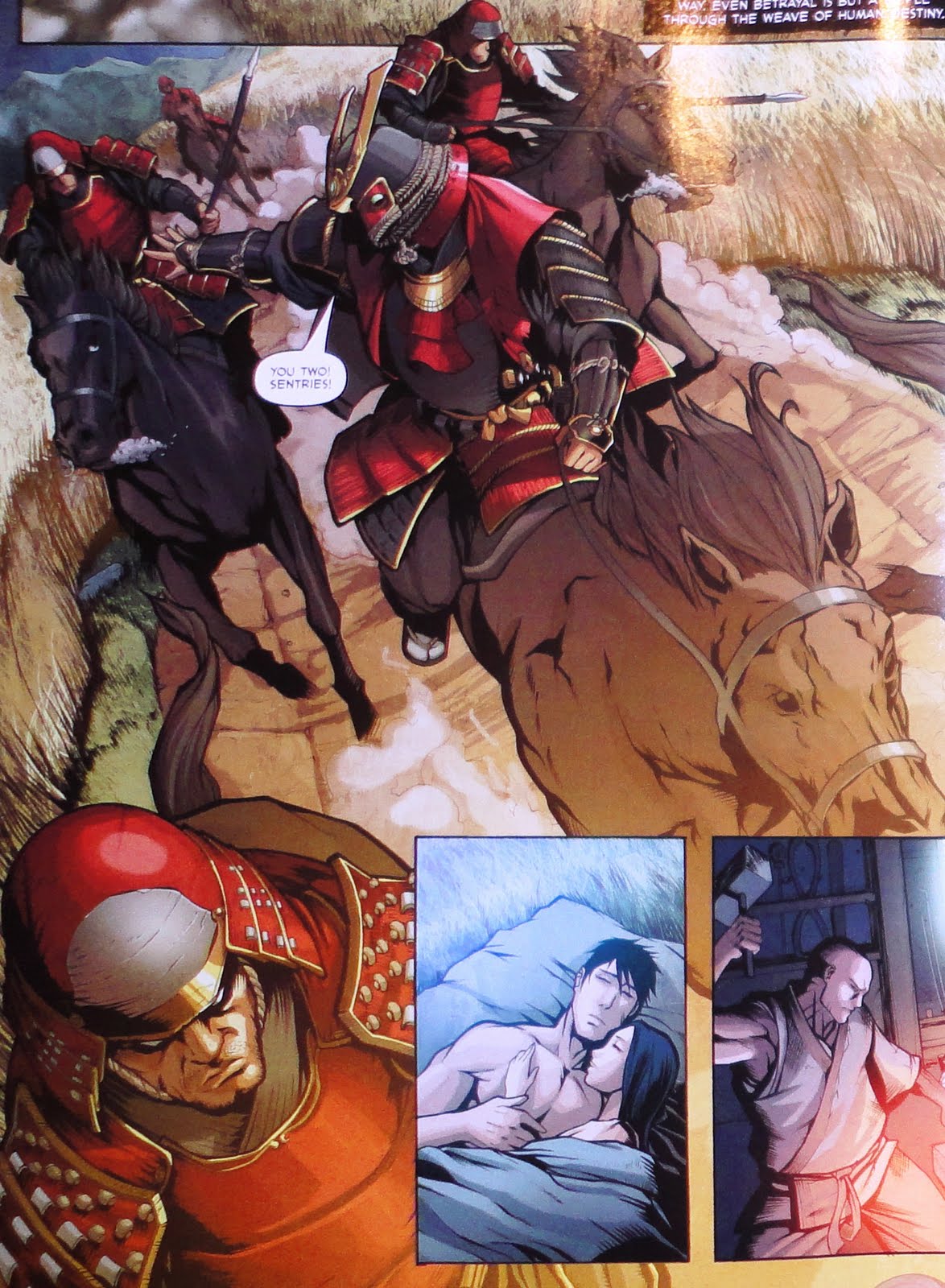
This is why at FanExpo Canada this past weekend I strayed from my usual superhero comic fare and picked up the first two copies of Samurai’s Blood by a Benaroya Publishing/Image Comics team led by Owen Wisemen and Nam Kim. Samurai’s Blood is a limited series which takes place against the backdrop of Tokugawa Japan and gives the reader an opportunity to explore this fascinating period using comic books.

(Above and below panels from Image's Samurai's Blood #1, June 2011)

The first issue begins with the brutal betrayal and execution of the Sanjo Clan in their province and elsewhere. As the clan is reduced to a rump, we are introduced to the young daimyo (feudal lord), his sister Yuko, and the soon-to-be-star of our series, his friend and talented samurai retainer. In a harrowing final scene, these remaining Sanjo escape and the second issue begins with the trio finding themselves in a nearby city. After they are accosted by enemies and Yuko is captured, they meet an elder swordsman who offers to train the samurai and ultimately help the Sanjo towards vengeance and vindication. Think Dune meets Bloodsport and you get the idea.

So while the series contains a number of reoccurring themes in fiction, Wiseman’s writing is sharp and he has done his homework in setting the story against the complexities of feudal Japan. These Japanese details, in turn, give the American comic an authentic quality; while keeping it accessible for those who might not know about Japan in the 1600s. Most panels include a caption with has some haiku-type samurai wisdom, which both contributes to the story and gives the reader something deeper to think about. I’m not sure if this has been taken from a popular samurai-era text, but a quick look at Wisemen’s biography will reveal a long-time interest in Japan means famous texts like Musashi’s Book of Five Rings have almost certainly been consulted.

(Above and below panels from Image's Samurai's Blood #2, July 2011)

The artwork is great too. While there are obvious Japanese influences, it never-the-less remains accessible to those of us (myself included) who don’t particularly enjoy Manga. Details such as training with bokken (wooden swords), the samurai armour and Japanese urban geography all contribute to the storytelling and do well at portraying pre-industrial Japan. It is a rather violent comic, so I would not recommend it for children or even early teenagers, but the drama and complexity of Japanese society (and the expensive DC relaunch!) probably makes this age-appropriate suggestion moot.

So if you’re looking for a break from the mainline superheroes and want something with both action and human drama, give Samurai’s Blood a look. It’s a good story that has captured the complexity and majesty of feudal Japan, while presenting drama enjoyable for the unfamiliar Western reader. This comic also underscored what I consider the best part of any comic convention: the unexpected surprises you find there. Samurai’s Blood was this year’s surprise for me, and while it hasn't been on my pull-list before, it certainly is now.

Samurai’s Blood #3 is in stores now.