Sunday, July 1, 2012

Happy Canada Day!

To mark the occasion here are my top five 'Canada and Comics' convergences. Enjoy:

5) Wolverine joins the X-Men.

All Images from Marvel's Giant-Sixe X-Men first published in 1975 and reprinted in 1991.

This could be considered treason by some, but I think by taking a potentially one-off character and putting him in the X-Men, Marvel gave this Canadian front-line exposure which allowed him to reach the prominence he would later experience.
 
4) First appearance of Captain Canuck. 

From Comely Comix Captain Canuck #1 (July 1975)
What's a Canadian comic without a snowmobile? From Captain Canuck #1.
This book featuring a Captain America look-a-like was released by Comely Comix in 1975. It featured a future where Canada had eclipsed the USA as a superpower and was as much science-fiction as it was superhero. Captain Canuck has since been featured on a postage stamp and there's even talk of a feature film. 
3) Logan fights on D-Day

All images from the great book Marvel's Wolverine #34 (December 1990) written by Larry Hama with art by Marc Sivestri.


Probably the least well known of this list; in Wolverine #34 we learn Logan (Wolverine) jumped on D-Day. Canadian troops launched at Juno Beach during Operation Overlord and played an important role in beating back the Nazi menace during the entire Second World War. Go Canada!  

2) Prisoners of Gravity

This Canadian television program remains (thanks to YouTube) a great source for anyone interested in the history of our medium. It has been talked about on such prominent podcasts as Word Balloon and has one of my favourite interviews with Jack Kirby. Have a look.

1) Alpha Flight Arrives!
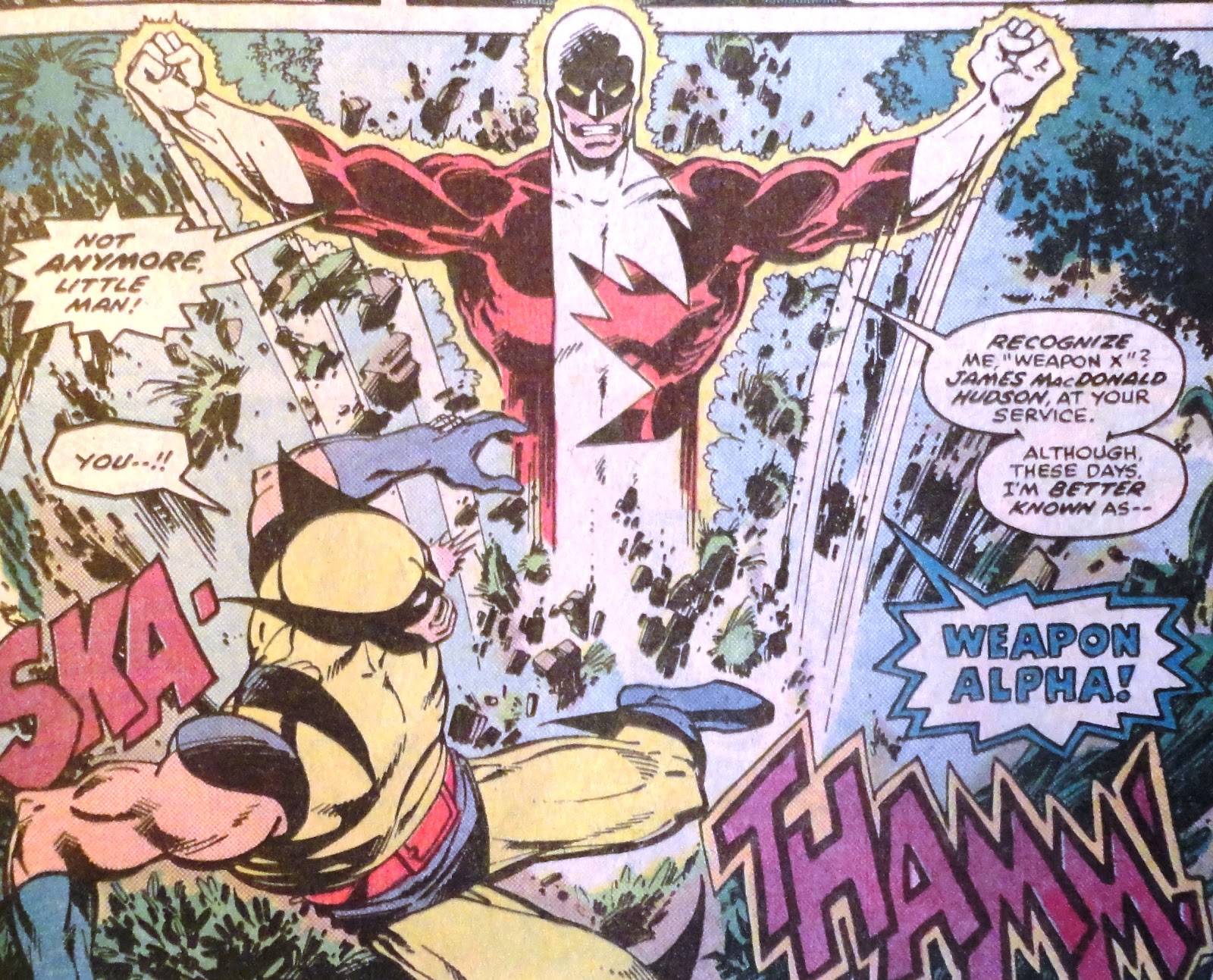
The story of the first meeting between Alpha Flight and the X-Men. From Marvel's Alpha Flight #17 (December 1984)
From Marvel's Alpha Flight #1 (August 1983)
Alpha Flight first appeared in Uncanny X-Men #120 (1979). Created by John Byrne, this group would eventually get its own series and give comics readers a number of great characters and moments. Northstar, one of the original Alphans, has come to prominence in recent weeks as one half of the first same-sex marriage in the Marvel Universe.

So there you go. Have a great Canada Day and thanks again for reading.

Tuesday, June 19, 2012

British Markets & War Comics

First off, my apologies for not writing in almost a month. Between exams, meetings, jet lag and weddings, I've been busier and more tired than ever. But after a month long hiatus from writing, things are somewhat back to normal and I hope to get some comic reviews and features out in short order. Today's piece mixes comics and travel and I hope you enjoy it. 
Portobello Road Market in Notting Hill.
When you visit London (or most any other British city) sooner or later you happen upon a market that sells almost anything. London is full of them and a couple weeks ago I visited one of that city's most famous: The Portobello Road Market in Notting Hill. It was featured in a Hugh Grant and Julia Roberts film a couple years back and remains a major tourist attraction.
There's a mix of British and American comics to be found in the book stalls of most UK markets.
...along with other cool books
...action figures and toys
...and suits of armour. This is England, after all!
While there wasn't a lot of comics related items, there were the usual sequential art gems that I've noticed consistently show up at these markets. These includes the magazine-sized British editions of American comics, late 80s and early 90s US comics and some cool British war comics, of which I bought these three:  


Published from the late 1950s these comics differ quite a bit from American comics. They are smaller (7 x 5.5 inches) and have on average two black and white panels with a typed font on the page. Having about 66-68 pages per book, they result in about the same length of a modern comic and the art is good and realistic. Their coolest feature however is their fantastic insight into an idealized vision of British machismo and patriotism in the post-war period. 

For example, The Railway of Death story tells the tale of ne'er-do-wells from a Scottish suburb nicknamed 'The Shambles' and how a benevolent army Lt. Colonel persuades the courts to allow them to become a regiment in lieu of going to jail after a major brawl. Along the way they encounter a rough training process, burnt down canteens and class-based prejudice from an established English county regiment before eventually becoming the victorious defenders of British India. 
In a Bridge on the River Kwai-type story, these 'Jocks' (a somewhat archaic and mildly derogatory nick-name for Scotsmen) do their duty against the Japanese.
Before that they were getting into street fights in 'The Shambles'...
...and feeling age old British class based prejudice from a 'County' regiment of 'Guardsmen'. 
They made mistakes along the way...
..but eventually found their way as good British soldiers. This was from the final splash. 
In the book Special Force there is a similar story of redemption in the military setting. Here a naval Commando on manned torpedoes or 'chariots' washes out after a failed mission in France. From there he decides to leave the navy to join a parachute regiment only to soon be forced to team with his old colleagues to destroy a German dam.

'Special Forces' largely developed in the Second World War.
This story features chariots or manned torpedos.
... and the paratroopers.
and redemption -- all with the goal of beating the 'Jerries'.
The book The Lost Army by Commando War Stories in Pictures* was  different. This book told the story of action in the African desert, albeit with an archaeological twist. These 'Britishers' while trying to take out the treacherous 'Jerries' and led by a brainy corporal named Bill 'Prof' Stanley get help from some unlikely allies: a lost ancient Persian Army.

Mixing ancient history and modern warfare, this book was somewhat different from the previous two.
In a story fitting of Indiana Jones, these are not ghosts but descendants of an ancient army. It's never explained how these men reproduced for a hundred generations or how they find food in the middle of the North African desert, but those niceties are not needed. The fact is they help the British defeat the Germans and destroy the secret Afrika Korps base. Blimey! 

Persians and British fighting the Jerries in the desert.
A great closing splash from The Lost Army.
If you're ever in the UK and visit a market you'll be sure to find some of these cool old war comics. The Railway of Death was published by IPC Magazines 1972 (first in 1961), Special Forces by IPC Magazines in 1980 and The Lost Army by Commando in 1974 (first in 1966). They offer great insight into the British mentality during post-war period and are a cool comics souvenir. Please feel free to leave a comment if you've come across some cool comics-related items in your own personal travels. 

*Commando War Stories in Pictures has been publishing from the early 1960s and still publishes today.

Tuesday, May 22, 2012

Bram Stoker, Dracula & Highgate Cemetary

(So Twitter told me today was ‘World Goth Day’. And while I’m not exactly sure what that entails, here’s something that may interest those of responded to the hashtag from my Twitter account.) 

It’s not very often that an author gets to lay claim to inventing an entire genre. Jerry Siegel and Joe Shuster, the creators of Superman have a reasonable claim to having invented the Superhero genre. Likewise, there's an argument to be made that my favourite author J.R.R. Tolkien invented the High Fantasy genre. Another such creator is Bram Stoker, the author of the Gothic Horror classic Dracula. An Irishman, Stoker starting writing while working as a manager at London's Lyceum Theatre. After researching European folklore and mythology, he produced Dracula which was published in 1897. And while strictly speaking his novel was not the first vampire novel, it launched the genre into the world like none before it. Indeed, Dracula's popularity would eventually reach stratospheric heights, first appearing in film in 1922 and many since. He has also proved a popular comic book villain too.
Dracula in Marvel's X-Men: Curse of the Mutants, July 2010
Being a long-time Dracula fan, I decided recently to go up to Highgate Cemetery in London and take some photos. This place has long been understood to be a locale that inspired Stoker, with my tour guide even saying he sat and wrote in the cemetery itself. Highgate is one of the Magnificent Seven cemeteries which were founded as London grew in the early Victorian period. As you’ll see, it's hauntingly beautiful and if you're ever in London I highly recommend a visit. Nearby Hampstead Heath and the village of Highgate are nice too so make a day of it.

The Highgate Cemetery chapel

The stone, green and quiet all make for an otherwordly place in the midst of London.

Being quite overgrown the cemetery also serves as a nature reserve.
Stone Angel
This is the famous Cypress of Lebanon and is said to date back to the 1690s. Bram Stoker would have looked upon this tree as he wrote.
This is one of the spots where Stoker was said to sit in his chair and write.
Amazing trees!
The final resting place of the great scientist Michael Faraday.

Wednesday, May 2, 2012

And Hulk...SMASH: A Review of Avengers

Director: Joss Whedon

Starring: Robert Downey, Jr. Chris Evans, Mark Ruffalo, Chris Hemsworth, Scarlett Johansson, Jeremy Renner, Tom Hiddleston & Samuel L. Jackson

I wonder when Stan Lee and Jack Kirby created the first Avengers comic in the early 1960s, if they had any idea that one day their characters would be featured in a massive feature film that is projected to make hundreds of millions of dollars. Or that some of the world’s biggest movie stars would don the guises of their creations. I doubt they did but fortunately for Stan Lee, he has been able to see his creations one the silver screen. But because Jack Kirby didn't, he passing away in 1994, I've decided to sprinkle this review with artwork from the original comic Avengers #4 (March 1964) which featured Captain America joining the team. Kirby drew this book and is consired a legend in the comic medium and because of this I'm happy to give him the praise he deserves -- including this opportunity. 
Iron Man and Thor in Marvel's Avengers #4 (March 1964)
But let’s get on to the film. I will not be spoiling here, so if you've seen the trailer you should be fine.
  
WOW. Just wow. It’s a fantastic movie! And while I know I've been a little too easy on some films in the past (see my Green Lantern review -- what was I thinking?!?) this one deserves to be called fantastic and really is worthy of the hype its received. With regard to the characters and actors: as enemies go Loki (Tom Hiddleston) was a good in his role as the Machiavellian leader/puppet of the alien invaders and other stars including Samuel L. Jackson (Nick Fury), Chris Hemsworth (Thor), and Jeremy Renner (Clint Barton/Hawkeye) were great, with special praise going to Renner who, along with the prop department, was able to take an ancient yet potentially mundane weapon (bow and arrow) and turned it into the realistic tool of a top secret agent. Chris Evans contiues to make a good 'Greatest Generation' Captain America and Scarlett Johansson (Natasha Romanoff/Black Widow) was the strong female lead this testosterone charged film needed. But of the all-star cast, Mark Ruffalo (Bruce Banner) and Robert Downey Jr. (Tony Stark) stole the show.  Ruffalo because he played the conflicted genius that is Bruce Banner so well and Downing Jr. because he is Tony Stark and was all of the sardonic, playboy brainiac we've come to know and love over the course of this superhero film franchise.
From Marvel's Avengers #4 (March 1964)
But as we all know a film cannot live on acting alone – it also requires decent plot cohesion that can be difficult when there is so much back story to cover. But in this case it worked. It may have seemed slightly crowded at the beginning of the film, but by the middle act, when everything was going south for the Avengers, you see the team start coming together and are already hungry for the sequel. By the final battle scene where Captain America takes command, you really get the sense it's working. Iron Man and Thor remain themselves yet accept orders from the Captain and in the Hulk we we get to see why comic books have been written about how he's one of the most the powerful characters in the Marvel Universe. Indeed, the scene where Captain America gives the orders in my mind captured the essence of the film perfectly and still counts as only the second best in the film. The top honour goes to the final scene when we get to see what's in store for us next time. That scene had me smiling and fist-pumping all the way home. 
Captain America getting back in Avengers #4 (March 1964)
So there you go: a short, gushing exam-time review of Avengers. All in all, it was great escapist fare for both Fanboys and laypersons alike. Those of us who know comics and their back stories will really enjoy it (especially the final scene!) but if you’re bringing along a girlfriend, sibling, friend or parent they’ll enjoy the action, drama and humour too. Oh, and comics fans, if I haven`t already made this clear: stay in your seats! The final scene has everything you`ve been hoping for.

4.5/5 Stars

Saturday, April 14, 2012

WGTB reviews Dragonstorm #1

After having read and reviewed Stormchasers #4 by UnstoppableComics last month, I decided to follow-up with the publisher and get another comic. Why not right? I liked it last time and I've been doing my best think outside the Big Two box lately and read stories I might otherwise not come across. What I got was one of Unstoppable's latest offerings, a book called Dragonstorm #1 which did not disappoint. 
Unstoppable Comics' Dragonstorm #1 (April 2012) created, written and lettered by Jaydee Rosario with cover by Pat O'Donnell and pages 1-9 interior art by Joel Cotegar (inks by Alex Riveera) and pages 10-22 by Craig Shepard (inks by Michael Summers). 
First off, the name 'Dragonstorm' and the cover caught my attention right away. Having lived in Japan, I'm always willing to give anything that even remotely references the great ancient cultures of Asia the benefit of the doubt. But as I was reading the book and learning about the namesake hero, I soon realised Unstoppable was trying to pull a fast one. The true protagonist of this story is not Dragonstorm, but actually a teen-aged girl named Lyllian and this really sparked my interest. Indeed, much of the story is all about how Lyllian and Dragonstorm came to meet each other and how this sets us up for what could be an interesting dynamic for the rest of the series.
Lyllian and Dragonstorm from Unstoppable Comics Dragonstorm #1 (April 2012) Dragonstorm himself resembles a cross between Nightwing and (Marvel's) Captain Marvel.
You see (and I'm trying to be careful not to give things away here) Lyllian's mother and father are now out of the picture (euphemism!) and her own grandfather has forced Dragonstorm to train her for a task that has yet to be revealed. However, it is also made very clear to us that Dragonstorm is not the Grandfather's friend and Grandpa in this case is not a jujube dispensing nice guy (like mine is!) but rather the enemy and chief antagonist of the series. Okay, I’ve probably already given too much away, but this overall premise, while being somewhat similar to other stories, is never-the-less different in that it focuses on a female lead, which even in today's market is something irregular.* Suffice it to say, it will be interesting to see how this male/female -- guardian/ward relationship develops and could be a refreshing change for comic fans. 

While a common trope in comics, Dragonstorm is aiming to introduce the Guardian/Ward dynamic within the context of a male/female relationship. Risky perhaps, but could this also be in interesting innovation? Image of Bruce Wayne and Tim Drake from DC's Batman #654 (June 2006).
Moving on to the art, these responsibilities were divided with the first half of the book done by Joel Cotejar and the latter by Craig Shepard. Both artists did a good job and the panels, while more Image Comics mainstream than Big Two mainstream (take from that statement whatever you'd like), never-the-less complement and amplify the story. With regard to their portrayal of the Dragonstorm himself, I think he has some cool powers, including a wing-shaped force-field, and I look forward to learning how he came about as well as how he develops and changes over time.

Dragonstorm's 'wings' in Dragonstorm #1, April 2012
Grandpa's quite the baddie in Dragonstorm #1, April 2012
So there you go. Somewhat brief thoughts on the latest from the Unstoppable Comics stable. If you can get your hands on a copy of Dragonstorm give it a shot -- it's always good for us readers to look beyond the Big Two to see what the newer guys are doing. I've linked to their company's website above if you're looking to track down a copy and please let me know what you think about the book in the comment section below. 

*NB: I'll probably be stepping away from the blog for the next little bit (I have other scholastic commitments) but once again thanks for reading WGTB and please feel free to leave any comment about the blog. I'm still relatively new at this and always looking to improve. Also, if you're looking for a great conversation about the issue of female super-hero leads check out the most recent conversation between Kelly Sue DeConnick and John Siuntres at the Word Balloon podcast. It's very good.

Friday, April 6, 2012

V for Vendetta and Guy Fawkes

While travelling the London Underground a few weeks back, I brought along a copy V for Vendetta by Alan Moore and David Lloyd. I hadn't read it since the film release in 2006 and wanted to enjoy it now that I was living in London. Originally a ten issue series released between September 1988 and May 1989, this story has since been reprinted in trade paperback numerous times and become a modern classic known to both fanatical and casual readers of comics alike. 
'V' from Vertigo's V for Vendetta originally published 1988-1989. Republished in 2007.
V for Vendetta tells the story of a dystopian United Kingdom, that while having avoided the carnage of nuclear war, has never-the-less survived the global political and economic collapse by walking the dark path of totalitarianism. ‘V’ our protagonist, is the mysterious and dramatic character who having been incarcerated and experimented upon by the government, uses the superpowers he acquired during these experiments to change the UK back to the free society it once was. He does this with the help of a young prostitute named Evey Hammond and wears the guise of a 17th century English revolutionary as he does it.

"V' again.
V for Vendetta is right up there with Watchmen as a masterwork of the genre and because of this I won't comment much more on the work itself. Rather, I'd like to take this opportunity to talk about one of the images that anchors the story throughout: Guy Fawkes, the above mentioned revolutionary. 

The story is about how 'V' takes his revenge and changes UK society.
Born in April 1570 in York, Fawkes lived in a time of religious tumult. During the reign of King Henry VIII, the Church in England had become the Church of England and broken with the Catholic Church in Rome. Henry's daughter, Elizabeth I, continued to foster this schism, but there was still many questions about the two faiths during her reign and beyond. Indeed, parts of Northern England were especially resistant to the Church of England and among these 'Recusants' numbered Guy Fawkes' step-father. Guy himself would eventually convert to Roman Catholicism. 

The Guy Fawkes mask worn by 'V'.
And events in England were not taking place in a vacuum. Indeed, much of Europe was embroiled in religious based wars and soon Fawkes found himself fighting for the Hapsburg Spanish in their rebellious Dutch provinces. When a temporary peace returned in that area in 1598, Fawkes returned to England where he fell in with a group of conspirators wanting to assassinate the protestant King James I, a Scot who had ascended to the English throne upon the death of his cousin Elizabeth. On the fifth of November 1605, the King, having been invited to Westminster to take part in the State Opening of Parliament, was supposed to go to Westminster where the conspirators were to explode their stashed gunpowder underneath him,  thereby killing him and much of the England's parliamentary and legal establishment. The attempt failed when it was uncovered by the King's officials and Fawkes and his co-plotters were taken into custody.
The Great Hall of the Palace of Westminster. This may have been the view Guy Fawkes during his trial.
Not without irony, Fawkes trial occurred in the Hall of Westminster, the oldest existing part of the Palace of Westminster. Now largely used for joint addresses of Parliament or other state events, this hall until the late 1800s also served as a courtroom. The indictment against Fawkes was interesting because while 17th century England had a distance to go before resembling today's justice system, the Fawkes trial was laced with language that would be anathema to any idea of natural justice. For example, most counts of the indictment are preceded with adjectives such as ‘treasonous’ or ‘traitorously’ whereas the potential victims of the crime are nearly always proceeded with ‘virtuous’ or ‘gracious’ in front of their names or titles. 
Looking at the Big Ben and the Clock Tower of the Palace of Westminster outside the doors into the Hall of Westminster.
So as you can probably guess, Fawkes and his co-conspirators were found guilty of their crimes, tortured and killed. Fawkes, never-the-less escaped the fate of a rope around his neck, when he jumped off the gallows and broke his neck before the executor could place it. He was still quartered and since then the fifth of November has subsequently become a night to celebrate the King's survival. 
The UK leader and V's antagonist, Adam Susan, monitors things in V for Vendetta
But back to the story at hand, it is a true testament to the power of V for Vendetta that the image of Guy Fawkes has surfaced in the imagination of many throughout the world as a protest figure. Indeed, his 'face' is now seen in many places -- from the Occupy Movement to the online group Anonymous. Naturally, this may have something to do with the 2006 feature film, but it is still demonstrative of the awesome power of this comic story. David Lloyd's idea of bringing Guy Fawkes to a modern context and Alan Moore's poignant and gripping story gives modern readers a new reason to explore the fascinating legal and political story of the man behind the mask. Go read V for Vendetta if you haven't already, and if you have, I hope you've enjoyed this little to voyage into English history.