Showing posts with label Science-fiction. Show all posts

Tuesday, December 30, 2014

The Star Trek Franchise: 1966 to 1979

We appreciate your interest in “Star Trek” and are sorry we have to continue to disappoint you. NBC, however, has no plans for the return of the series.

As reported in recent press stories, our Program Department does have under consideration a two-hour-science fiction film. Several concepts have been proposed for this project – one of which is “Star Trek”. While no decision has been made — nor can we tell you when one will – we are aware of your own high regard for “Star Trek” 

 NBC Audience Services

Title of Star Trek: The Original Series which aired from 1967 to 1969.
This short statement is what those who wrote letters to NBC received in reply to their correspondence. It was written on a post card and was most certainly read by thousands of disappointed fans in the immediate years after the cancellation of the first Star Trek television show. Of course, what came before this is one of sci-fi fandoms best known results – a letter writing campaign that saw NBC receive almost 116,000 letters between December 1967 and March 1968 – which kept Star Trek from being cancelled after its second season. However, what you might not know is that while Star Trek was on life-support almost as soon as NBC first aired the show on television, there were also licenced and Paramount-owned products that further enriched the fan's overall experience with the franchise, almost from its very beginning. This short piece will look at early Star Trek licenced and spin-off products and hopefully give you a sense of how fans were able to consume Star Trek in the earliest days of this now venerable franchise. 

The crew of the USS Enterprise from Star Trek: The Animated Series.This show featured the voice talents of the Original Series actors but only lasted two seasons.
In 1972 NBC went to Filmation and Norway Productions which – working with Desilu Studios who produced the live-action show in the early seasons, and using the same actors who portrayed the original crew – produced two seasons, one of 16 episodes and the other of six of Star Trek: The Animated Series which expanded the in-canon universe and filled the void felt by an increasingly vocal fanbase. Since the last airing of an episode in June 1969, the 79 episode show almost immediately went into syndication. Indeed, as its popularity started to grow, fans started to organize and the very first Star Trek convention was organized in 1971 by Elyse Pins, Devra Landsam and Al Schuster and took place on the weekend of January 21-23, 1972 at the Statler-Hilton Hotel in New York City. This event was covered by Variety, the trade publication, and featured sci-fi legend Issac Asimov, along with the king and queen of Star Trek themselves, Gene Roddenberry and Majel Barrett. 

The cover of the Gold Key Comics' Star Trek #4 (June 1969) with a reprint as Star Trek #35 (November 1975). Written by Dick Wood with art by Alberto Giolitti. Unless otherwise noted, all subsequent images are from Star Trek #4.
Comic book fans will appreciate that Star Trek comics started to appear on the shelves of stores in July 1967, shortly after the first season had completed. They were published by Gold Key Comics, an imprint of Wisconsin-based Western Publishing and interestingly, these books didn't come out with the frequency of other, more established comic publishers. The first was available in July 1967 and called the The Planet of No Return; the second called The Devil's Isle in Space and not available until March 1968. From there The Invasion of the City Builders appeared in December 1968; The Peril of Planet Quick Change in June 1969; The Ghost Planet in September 1969; When Planets Collide in December 1969; The Voodoo Planet in March 1970 and The Youth Trap in September 1970, the latter five issues having been produced after the television show ceased filming in January of 1969. The early comics universally featured a still photo of the television crew (usually Kirk and Spock) on the cover, but the similarities ended there. Have a look: from June 1969's Star Trek #4 The Peril of Planet Quick Change: 

Sulu beams down the crew to "Metamorpha", a quickly changing planet. Where's the Redshirt?

When you special effects budget is limited to what the mind can imagine, Star Trek can get kinda crazy... 

... and even use heavy machinery which was rarely seen on the television show. In the comics they were common place. How did they beam this tank down?

Splash from Part II of Star Trek #4.The comics were divided into chapters.
Not beholden to budgets or technology, the comics were much more detailed in their depiction of alien life and worlds. And the Enterprise crew always seemed better equipped with tools and rucksacks too. In a similar vein, the comics also make it clear that the artists had very little contact with the television show, with the backgrounds and crew tools being very different from the set designs of the television show.   
Splash from Gold Key's Star Trek #31 (July 1975). The writer of unknown but the art is by Alberto Giolitti.

Star Trek #31 was titled The Final Truth and had a Gamesters of Triskelion feel to it  – but with robots! 
First piece of licenced original Star Trek prose fiction was titled Mission to Horatius and was written by author Mack Renolds and published by Whitman Books (which was also owned by Western Publishing). It was the first original piece, as there had been previous Star Trek "novels" but they were actually adaptations of the television series from Bantam Books starting in early 1967. Following Mission to Horatius, Spock Must Die! by James Blish – which as the title suggests, was targeted more at adult readers – was released in 1970. Interestingly, despite the growing popularity of Star Trek and hints from Gene Roddenberry himself that the show might come back (which were most pronounced in the lead up to the failed launch of Star Trek: Phase II in 1978), the next Star Trek novel was Spock, Messiah! which was released in 1976 and written by Theodore R. Cogswell and Charles A. Spano Jr.  After the second novel, the Star Trek universe took off and novels based on the franchise proliferated. 

Cover of Spock, Messiah! by Theodore R. Cogswell and Charles A. Spano Jr. Published by Bantam Books.
Both Star Trek novels and comic books would bounce from publisher to publisher, in the latter case with Marvel Comics picking up the licence for a short period beginning in 1979 with the comics adaptation of Star Trek: The Motion Picture. However, that will be discussed later in the next installment of this ongoing mission based on the Star Trek Franchise where we will look at the 1980s and 1990s, covering the bulk of the Star Trek feature films as well as Star Trek: The Next Generation. Thanks for reading and have a great day!   

Monday, March 3, 2014

Exploring the Nebulas: 1978 winner Vonda N. McIntyre's Dreamsnake

Taking place in the distant future, Dreamsnake by American writer Vonda N. McIntyre, tells the story of "Snake" a Healer on a post-apocalyptic, radioactive, unforgiving Earth. Healers in this period are highly respected and equipped to handle health emergencies in a place that has largely forgotten modern medicine. When Snake's only dreamsnake is accidentally killed while helping a patient, she is professionally hobbled and embarks on a quest to find a new one. Along the way McIntyre details a quest riddled with hazards, hostiles, odd sexual mores and a decimated landscape all of which leads to a fascinating and provocative story. Unlike so much science-fiction, the story has no obvious “offworlders” but does make it clear that there has been contact with extra-terrestrials and this becomes an important part of the story by the end of the book. Along with winning the 1978 Nebula award, Dreamsnake was also the recipient of the 1979 Hugo award from the international science-fiction community.


Dreamsnake, Vonda N. McIntyre, Houghton Mifflin, 1978, pp. 277
Dreamsnake has the heavy undertone of drug use and culture that one might expect from a book published in the 1970s. Indeed, Snake’s primary method of creating medicine is by three snakes and the alchemy that comes from mixing their venom. The primary antagonist is also very much akin to a drug lord and it’s the magic-turned-science of the Dreamsnake that gives this book has much a fantasy feeling to it as a science-fiction one. So while strictly speaking I would label it a science-fiction novel, it has some intense fantastical elements to it and at times could almost be integrated into the elaborately constructed worlds of J.R.R. Tolkien or George R.R. Martin. The characters are both well developed and richly detailed and their convincing motivations do well to drive the story forward. With a number of the sub-plots, the story is also somewhat layered and gives the readable characters a humanity that makes the story as much about them as it does the odd new world.

This is not really the type of science-fiction I would normally buy and honestly I only read it because of the Nebula quest I'm currently on. But I’m glad I did. It was a worthy winner of the award for best novel from the Science-Fiction and Fantasy Writers of America for 1978 and a very Good read overall.     

Sunday, January 19, 2014

Exploring the Nebulas: 2013 winner Kim Stanley Robinson's 2312

Welcome to the first edition of Exploring the Nebulas, a new ongoing series from WGTB. In this series we will briefly review novels that have won the Nebula Award, the prize awarded by the Science-Fiction and Fantasy Writers of America as the best novel of that genre each year. The scale used to rate each book is one of three: Good, Great or Legendary and the first winner to be reviewed is also the most recent; 2312 by Kim Stanley Robinson.

2312, Kim Stanley Robinson, Orbit, 2012, pp. 576, C$ 29.00
2312 is Kim Stanley Robinson’s second Nebula win for Best Novel (his previous being Red Mars in 1993) and continues in a similar vein as a more 'high' or even literary science-fictional work. The book is set in the eponymous year and envisions the Solar System as a place where humans have moved to almost every major planet or planetoid available including Mercury, the home of our protagonist Swan Er Hong. Space travel is achieved through massive hollowed-out asteroid-ships called Terrariums that also serve as giant nature reservations or specialised theme parks. Other technological and societal advancements include space elevators on Earth and Mars; a moving city on Mercury; a free and independent Martian republic; a massive Venetian blind-like heat shield above Venus; the insertion of animal genetic material into human beings; as well as changes to human sexual organs. Despite all these amazing achievements, perhaps the most significant advancement is artificial intelligence that has both augmented the human brain and is on the verge of becoming its own political force. The Earth of 2312 is much less amazing and has become the "sad planet" with years of abuse and environmental degradation having left it a poverty stricken mess. Indeed, the damage caused by humanity has led to near extinction for many of its species and this is a major theme of the story. 

For the most part this Nebula winner is good, but is not without its problems. The book is interspersed with quasi-scientific "Excerpts” and “Lists” that provide insight into our future and at times are very interesting. But I also found that they could be distracting and towards the end of the story found them to disrupt the flow of the story which made the book feel longer than it needed to be. In 2312 Robinson also doesn't hide his politics and heartfelt belief that the prevailing economic system that we know, namely "capitalism", needs to be eliminated and the story has an economy of 2312 effectively extinquishing it by use of powerful computers. Personally, I'm highly skeptical that the future will confine capitalism to the domain of hobbyists and collectors as Robinson has, but the author is entitled to his opinion and – while having a significant political aspect to it – 2312 can be enjoyed by someone who doesn't agree with the author's politics.

The biggest problem I have with the book is that while it was very long, the ending was too Deus ex machina for my taste and appeared (paradoxically) rushed. I don't want to spoil the story for those who have not read it, but it's essentially a "who did it" caper, yet ends so abruptly and easily that it gnaws away at the suspension of disbelief every reader carries. Of course, it's likely that the intention of the book was that the journey was to be its own reward, and to this end it was speculative science-fiction done well. Not great, and by the final hundred pages I was ready to move on, but good. As such, it gets that exact rating: 2312 is a Good Nebula winner.   

*At the time of posting 2312 was the most recent recent Nebula Award winner for best novel. The ceremonies for the 2013 books take place in San Jose, at the San Jose Marriott, May 15-18, 2014.  

Sunday, January 12, 2014

Exploring the Nebulas: A New Series from WGTB

This year I’m starting a new blog series called: “Exploring the Nebulas”. Being a sci-fi fan, I’ve long understood the importance the Nebula Awards have to readers and writers of science-fiction and fantasy. Yet, while I’ve read a lot of these books, I haven’t yet read them all and have wanted to do so for many years. So to start 2014, I'm setting out to accomplish this goal and will write a short review for this blog after each book.  

Logo of the Nebula Awards.
As I'm not a particularly fast reader, this is a significant time commitment and I may not get it accomplished before the natural life of this blog comes to an end. But I’m going to give it my best and may even cheat by posting reviews of winners I've read within recent memory. I've also decided not to keep any specific time commitment (a book per week for example) or to read them in chronological order, so this should make things a little more manageable. Also, reviews will not be long, and given that each book has already been well received, I will won’t pick them apart. I will however point out where I think they might have been better and note how the genre has evolved from the first winner Frank Herbert's Dune (1965) to its most recent, 2312 (2012) by Kim Stanley Robinson. I’ll also note any sequels, prequels, comics, television shows, films, etc. that are related and of interest to readers of this blog.

As well as documenting winners, I’ll also read and review significant runners-up or books that with 20/20 hindsight might have won the prize instead. The best example of these would be George R.R. Martin’s, A Game of Thrones, A Clash of Kings and A Storm of Swords which were nominated for the Nebula Award for Best Novel in 1996, 1997 and 2001 respectively but did not win. These novels are now (arguably) more famous than any other winner or nominee thanks in large part to the popular HBO television series Game of Thrones. 

Title card of HBO's popular television show Game of Thrones. This led to a resurgence of George R.R. Martin's books with A Game of Thrones reaching #1 on the New York Times Bestsellers List in July 2011, 15 years after its initial release.  
What are the Nebula Awards? 

The Nebula Awards stand at the pinnacle of American science-fiction and fantasy writing. They are voted on each year by members of the Science Fiction and Fantasy Writers of America (SFWA), a professional association that works to advance the interests of its members. To qualify for membership, one must have sold one novel or script or three short stories and membership is not exclusive to Americans. The SFWA's Nebula Awards are – along with their International cousins the Hugo Awards – presented each year to the winner. The five categories for the Nebulas include: Best Novel, Novella, Novelette, Short Story and Script. Perhaps unsurprisingly, while the first Nebula for Best Novel was awarded in 1966 and the first Hugo in 1954, there has since been considerable overlap, with the winner of the Nebula Award having won the corresponding Hugo on 22 occasions. 

The Nebula Awards for 2013 will be awarded In San Jose, California in May 2014 and I'll certainly follow that contest closely. In the meanwhile, I hope you enjoy Exploring the Nebulas and when the reviews are up, please feel free to voice any opinions you have about the reviewed book. And as always, thanks for reading WGTB.   

Monday, March 5, 2012

Remembering Ralph McQuarrie

On March 3rd, Star Wars conceptual artist Ralph McQuarrie passed away at age 82. 

Born in Gary, Indiana on 13 June 1929, McQuarrie would move to California in the 1960s where he would find work as a technical artist for Boeing. Soon, after transitioning into Hollywood work, he met a young filmmaker named George Lucas who asked him to take the ideas of his nascent space opera and put them onto canvass. From there, this art became the costumes, props and stop motion models of the original Star Wars trilogy, one of the most captivating and successful film series of all time. 

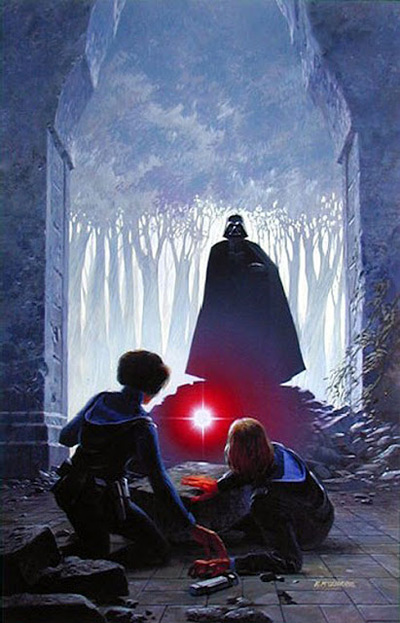
McQuarrie conceptual art for The Empire Strikes Back
In many respects, I owe a great deal to the partnership of McQuarrie and Lucas. In the early 1990s, I had given up on the superhero genre. It may have been because of the gimmickry and market saturation of that era, but not wanting to give up on comics entirely (and prompted by Timothy Zahn's Heir to the Empire novel) I turned to Dark Horse's Dark Empire comic series. From there I couldn't get a enough of Star Wars and after re-watching the films and reading the comics and novels, my imagination was once again captured by the majesty and grandiosity of that far away galaxy.

Then, in 1995, I was diagnosed with cancer and my entire world was turned upside down. Because the chemotherapy was so potent I was unable to read books -- which meant television and comics were all I could do to entertain myself when not sleeping or getting chemo. Because of this, the Star Wars galaxy became the escapist fare I needed while undergoing treatments and this entertainment was in large part due to the creative genius of Ralph McQuarrie. Thank you, Ralph. 
Cover of the book Splinter of the Mind's Eye by Alan Dean Foster. This story was originally intended to be the low budget Star Wars sequel if the first movie was unsuccessful.  
If you'd like to see some of this man's fantastic art, I've linked to two websites below. I'm also sure there are plenty of comic book artists who owe a debt of gratitude to Ralph McQuarrie too, so if you'd like to share a story please leave a comment in the comments section. If not, enjoy the artwork from the Star Wars and McQuarrie personal websites and I hope to speak with you again soon.